Content Usage Rights for Brands: What to Agree Up Front
How long and where a brand may use commissioned creator content, what to agree before filming, and what to do when the window ends.
 Written by Jack Evans7 min read

Content usage rights say how long a brand may run creator content, on which channels, and for what purpose. Agree the term, the platforms and the end date before filming, get it signed in writing, and diary the expiry. When the window ends, stop using the content or renew it with the creator.
On this page
- What are content usage rights for a brand?
- Why should a brand settle rights before filming?
- Which five terms make a licence complete?
- How do you agree the rights before the content ships?
- What happens when the usage window ends?
- What mistakes cause rights disputes?
- Where should a brand keep the rights on record?
Content usage rights say how long a brand may run creator content, on which channels, and for what purpose. Agree the term, the platforms and the end date before filming, get it signed in writing, and diary the expiry. When the window ends, stop using the content or renew it with the creator.
What are content usage rights for a brand?
You commission a creator video, it ships, it performs. Then the questions start: can we put paid behind this? Can it go on the website? Can the agency still run it next quarter? Every one of those is the same question: what did we actually buy?
So content usage rights are a licence attached to the video. They name where it may appear, how long it may appear there, and what the brand may do with it: post it, advertise with it, edit it. Paying the creator buys the deliverable and whatever licence the agreement spells out. It does not buy the creator's copyright.
Copyright starts with the creator. Under US law, copyright vests initially in the author of the work (17 U.S. Code section 201), and a transfer of ownership is not valid unless it is in writing and signed (17 U.S. Code section 204). The default is therefore simple: the brand has the permission the agreement grants, and nothing beyond it.
Most brands learn this quickly. Aspire's State of Influencer Marketing 2026, built on a survey of nearly 900 marketers and creators, found 77% of brands repurpose creator content in paid ads and 67% write usage rights into the creator's initial contract or rate. Influencer Marketing Hub carries both figures in its statistics roundup (Influencer Marketing Hub). Rights are not an edge case. They are the normal deal.
Why should a brand settle rights before filming?
After delivery the brand has nothing left to bargain with. The video exists, the creator has been paid, and asking for extra channels means asking for a favour. Favours annoy creators, and annoyed creators quote renewal rates.
Before filming, terms are cheap to set. The brief is open, the creator is still building the work, and one line in the agreement costs nothing. A brand that says it wants 90 days of paid use on TikTok and Instagram, plus its own website for 12 months, gets a number the same day. A brand that asks after launch gets an awkward message and a higher number.
Which five terms make a licence complete?
A licence covering these five terms is a licence a brand can act on. Anything missing is a decision someone will make later, without you.
- Use. What the brand may do with the video: post it organically on its own feed, run paid ads from the brand's handle, run ads from the creator's handle (whitelisting or Spark Ads), or place it on the website and in email.
- Channels. Named platforms, not "social". TikTok and Instagram is a different licence from TikTok, Instagram, YouTube and the website.
- Window. Start date and end date, both exact. A licence with no end date is a buyout the brand never negotiated or priced.
- Edits. Whether the brand may crop, subtitle, translate, add its logo or carry the creator's face onto a new claim. Permission to post is not permission to rewrite.
- End-of-term action. What happens on the last day: stop entirely, renew at a rate agreed now, or buy the content outright at a price named now.
How do you agree the rights before the content ships?
Five steps. The last one is a message you can copy.
-
Put the uses in the brief. Before anyone films, list every place the video will appear and for how long. A brief that says "for social" invites a dispute later; a brief that says "TikTok and Instagram, organic for 12 months, paid ads for 90 days" invites a quote. The Social Media Brief Generator gives you a brief structure to write those lines into.
-
Price the licence as its own line. Keep the content fee and the rights fee separate on the quote, because they renew separately. Influencer Marketing Hub's usage-rights clause library benchmarks paid social at 15 to 25% of the creator's base rate per 30 days, and whitelisting at 25 to 35% per month. Organic reposting on the brand's own channels is usually bundled in the base rate for up to three months (Influencer Marketing Hub). Worked on a US$300 video, 90 days of paid use on TikTok and Instagram lands between US$135 and US$225. The UGC Cost Calculator works the numbers before the call, and the creator's own view of the ladder sits in the usage rights guide for creators.
-
Get the term signed, not just discussed. A one-line clause is enough: the use, the channels, the start date, the end date, and the rate for renewal. The brand deal contract template carries the clause in plain English. A conversation is not a licence, and a signed line is.
-
Give the end date to everyone who touches the media. The paid social lead, the agency, the person scheduling posts. Put a calendar entry on the end date itself, titled with the video name, and check it in the same meeting where you review ad performance. Rights expire on a date, not when someone finally notices.
-
Ask for renewal before the window closes. Two weeks ahead of the end date, send this:
Hey Jess,

The 90 day window on the spring video ends on 14 March. It has
been our best performing paid creative, and we would like another
90 days on TikTok and Instagram from our handle.

Are you open to extending on the same terms? Send the renewal
number and we will get it signed this week.

[Your name]
A renewal asked for on the last day reads like a brand that never planned past launch. A renewal asked for a fortnight early reads like a client worth keeping.
What happens when the usage window ends?
On the day the licence ends, permission stops. Ads leave rotation, scheduled posts come down, and the file goes back to the archive. Keeping a copy for internal records is fine; publishing it is not. The creator's own post stays up, because that is the creator's account and the creator's copyright.
Three options on the last day: stop, extend, or buy out. Extending is the normal path, and the brand should expect to pay again for the new window. Content that performed in the first licence is worth more in the second, and most creators price a renewal at or above the original fee. A buyout ends every future renewal, so it is priced well above a single window and named only when the brand genuinely wants permanence.
Running the ads past the end date is a breach of the agreement, not a grey area. The creator can invoice for the extra use or require the brand to pull the content, and the relationship the brand wanted for the next campaign is gone. The cheap fix is the renewal message, sent two weeks earlier.
Working with a creator who uses The Creator List?
They'll send you a private link to the brief and agreement. You sign, review every draft and approve the final cut there, free. We take no cut of what you pay them.
What mistakes cause rights disputes?
- "We paid for it, so we own it." Payment buys the deliverable and the licence in the agreement. Ownership only transfers through a written, signed assignment.
- No end date. The most expensive omission on the list. Perpetual use then gets negotiated at renewal prices, or not at all.
- Rights agreed in a DM. Threads get deleted, people leave, memory fades. The agreement is the record.
- An agency still running ads in week 14. Send the end date to every hand that touches the ad account.
- Re-editing beyond permission. Crops, subtitles, translations and new claims on the creator's face are uses, not clean-up.
- Treating the creator's post as a free library. The creator posting the video does not extend the brand's licence.
Where should a brand keep the rights on record?
The Creator List is a private workspace for brand deals a brand already has, not a marketplace: no hiring, no booking, no matching through us. A brand joins free as the creator's invited client, with no fee on what the brand pays the creator, and the agreement arrives as one private link to sign, so the term lives in a document instead of a chat thread. The brief, the agreement and the dates sit in one place.
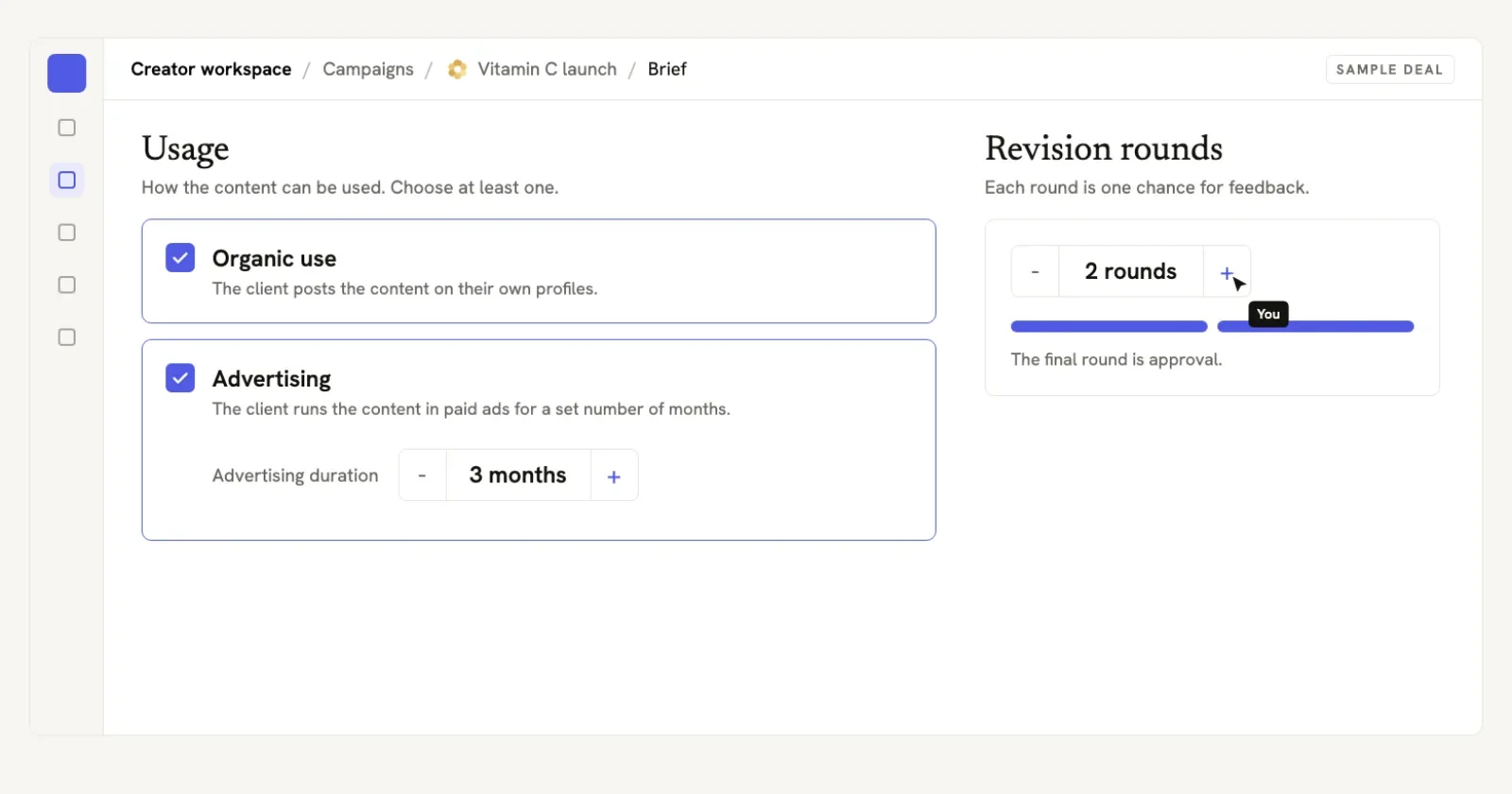
In The Creator List: the usage choices (organic, advertising and for how many months) beside a counter for revision rounds.
If you would rather keep the record in your own system, a shared document and a calendar entry work fine. The tool does not matter. What matters is that the term exists somewhere the whole team looks, before the video ships.
Your next action: before the next creator video ships, write the five terms (use, channels, window, edits, end-of-term action) into the brief, and ask the creator to confirm them in writing today.
Common questions
Paying a creator does not transfer copyright. The payment buys the delivered video and whatever licence the agreement grants. Copyright stays with the creator unless a separate assignment is in writing and signed, so a brand that needs permanent ownership should negotiate a buyout before filming rather than assume it after payment.
A 90 day window is the common first licence for paid ads, and 12 months suits organic posting on the brand's own channels. Brands extend when the first window works. Aspire's 2026 survey found 67% of brands negotiate usage rights into the initial contract, so the term belongs in the first agreement, not the second conversation.
When a creator licence runs out, the brand stops publishing the content: ads leave rotation, scheduled posts come down, and the file returns to the archive. The creator's own posts stay up. Publishing again requires a renewal agreement, priced for the new window and signed before the old one lapses.
No. Running ads after a creator licence expires is a breach of the agreement, not a grey area. The creator can invoice for the unlicensed use or require the content to be pulled. The fix is to send the renewal message about two weeks before the end date and sign the new window while the old one is still valid.
For brands
Working with a creator who uses The Creator List?
They'll send you a private link to the brief and agreement. You sign, review every draft, pin notes and approve the final cut there, free. We don't sell creators' time, and we take no cut of what you pay them.
Join the business waitlistRead next
 Perpetual Usage Rights: Should Creators Sign Forever?What perpetual usage rights in a brand contract really cost you, the time-limited counter to send instead, and how to price forever as a buyout.
 The Creator Paper Trail: From Brand Deal to Sign-OffA six-document checklist creators can run on every brand deal, from the first brief to sign-off, so payments land on time and disputes settle on evidence.
 UGC Creator Contract Template: What to Put in Yours as a BrandThe seven clauses a brand puts in a UGC creator agreement, plus a six-step way to write and sign it without a lawyer.
 How Long to Get Your First Brand Deal, Honestly ExplainedAn honest look at the first brand deal timeline: what sets it, why silence is arithmetic rather than rejection, and a weekly checklist to show whether you are on track.