Do You Need a Creator Contract? The Short Answer
The decision rule for when a creator contract is needed, the six lines worth having even on a small deal, and the copyable message that asks for them.
 Written by Jack Evans7 min read

Yes, you need a creator contract whenever real money is promised. A verbal deal is usually binding but hard to prove once terms are disputed, so a short written agreement naming the fee, deliverables, revision cap and payment date is enough. The message below asks for one in two minutes.
On this page
A brand has just replied to your rate with "we don't need a contract, we'll sort the paperwork later". Or worse, "we've worked with dozens of creators". You want the job. You also don't want to be the creator who makes a fuss over nothing. So you pause, and the deal carries on in a DM, where a creator contract never gets mentioned again.
The answer is simple. If money is involved, you need something written. Not a twelve-page agreement, not a lawyer, not a fight: a few lines both sides can point at later. This guide gives you the decision rule, the minimum worth having, and the message that gets it agreed today.
When is a creator contract necessary?
A creator contract is necessary the moment a brand promises you money, exclusivity, or a deadline you would be held to. Before that moment, a chat is a chat. After it, you have taken on an obligation, and the only question is whether the terms live somewhere other than your memory.
Verbal deals are not illegal. Contracts can be verbal, written or a mix of both, and the Western Australian Small Business Development Corporation puts the catch plainly: verbal agreements rely on the good faith of all parties and can be difficult to prove, so business arrangements should be in writing to avoid problems proving a contract existed (SBDC). That is the whole problem. Enforceable is not the same as provable, and a dispute is fought on proof.
Money disputes are common enough to plan for. A survey of 750 content creators in the US and UK by Wakefield Research for Tipalti found that 87% of the creators surveyed had experienced a payment problem: paid late, paid the wrong amount, or not paid at all (Tipalti). Most of those creators did not meet a fraudster. Instead, they met a fuzzy deal with no date to point at.
So when is a verbal deal enough? Only when there is nothing to enforce. Three cases:
- A brand sends a product and says post it if you like it. No fee, no deadline, nothing owed either way.
- An exploratory call where no number was agreed. Nothing has been promised, so nothing needs writing down.
- A reshare or a comment on your post, with no money and no exclusivity attached.
Everything else, including the US$300 job you almost didn't bother with, gets written down.
Why does "we'll sort the paperwork later" fail?
Because later never comes back. The person who said it moves on, the campaign ends, and your invoice lands in an approvals queue nobody remembers owning. Digiday reported in January 2026 that 30 days is still the typical payment window, while some creator campaigns now run to 90 or 120 days after publication (Digiday). So the conversation you are avoiding is the one you will need four months from now, with someone new on the other side.
There is a second cost, and it arrives long before the invoice. Nothing written down means no agreed number of revisions. Then comes one more small change, then another, and each arrives as a favour between people who are still being nice about it. Scope creep needs no bad intent. It only needs a missing line saying how many rounds are included. The scope creep guide has the reply that turns the next extra into a quoted one.
What is the minimum written agreement?
The minimum is six lines. Not a template with brackets in fourteen places, just the six facts that turn an argument into a lookup. Test each line with one question: could a stranger act on it without calling you?
- Who. Your name or handle, their name, their brand, one email address each. Handles change and staff move, so email is what survives.
- What. Exact counts, formats and dates. A Reel and three Stories, draft 16 Oct, live 20 Oct. Never "content for the launch".
- Revisions. Two rounds included, extras quoted before they start. One consolidated feedback email counts as one round.
- Use. How long they may keep the content live and whether paid boosting is included. Anything past that window is a new fee.
- Money. Fee, currency, invoice date, and days until payment. US$600, invoiced on go-live, due 14 days later.
- Exit. What happens if either side cancels. Half the fee for work already done is a normal line, and it reads as professional while you are still friendly.
That is the whole agreement. When the fee gets serious, or usage runs into paid ads and exclusivity, move up to the brand deal contract template, which is the clause-by-clause version. On an occasional deal, the six lines above are the difference between a memory and a record.
How do you ask for a simple agreement?
You are not asking for a lawyer. You are asking for a reply. Five steps, and the messages you need are in the section after this one.
- Frame it as paperwork, not suspicion. Open with the admin, not the law. You are confirming numbers you both already agreed, so write it like the boring confirmation it is.
- Give them the easy out. When the brand says no contract is needed, do not argue contract law. Send the six lines as a summary and ask for a one-word reply. Their reply is the record.
- Make signing take one click. The Creator List lets a client sign an agreement from one private link, or lets you record a deal agreed somewhere else so the terms sit with the project instead of in your DMs. It is early-stage software for brand deals you already have, so judge it on this one job. A PDF attached to an email does the same job with more typing.
- Set a deadline for the answer, not for the work. "If I don't hear back by Thursday I'll assume it's a no and hold the dates." Your calendar is the honest scarce thing here, and a deadline gets replies that vague agreement never does.
- Do not film until the words are written. Filming first hands them the upper hand: the draft exists, the launch date is fixed, and every term from here is a favour. Confirmation in writing, then roll.
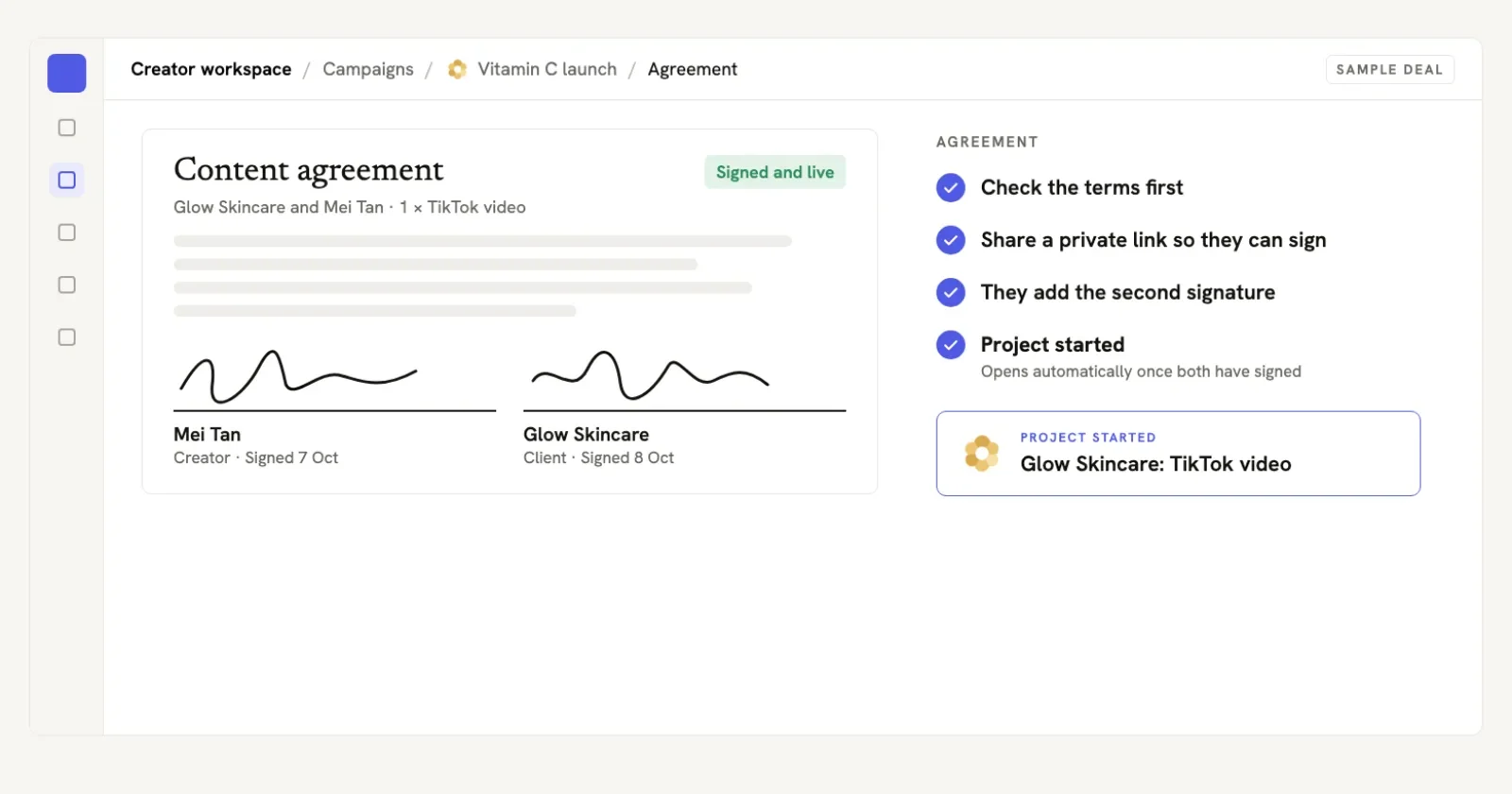
In The Creator List: an agreement signed by both sides from a private link, with the project opening automatically once the second signature is in.
What do the copyable messages look like?
Message one goes out while everyone is still happy. It reads like admin, because it is:
Happy to get started. Before I film, quick confirmation:
US$600 for one Reel plus three Stories, draft due Fri 16 Oct,
live by 20 Oct, paid within 14 days of it going live.
Reply "agreed" and I'll start today.
Message two is for the brand that says they don't need a contract. You are not arguing, you are summarising:
Understood, no formal contract needed. Just so we both have it
in writing: US$600, one Reel plus three Stories, two revision
rounds, live by 20 Oct, payment due 14 days after it goes live,
content usable for 90 days. Shout if anything looks off before
I start filming.
Message three is the reply you send when they go quiet. It states the deal and gives them a date to object:
Following up so I have this clear: US$600, one Reel plus three
Stories, draft 16 Oct, live 20 Oct, invoice paid within 14 days
of going live, usage for 90 days. If I don't hear otherwise by
Thursday I'll assume that's right and start filming.
Keep every message generic about them and specific about the numbers. The brand name stays out of it, the fee and the dates never do.

More brand deals, paid what they're worth.
Pitch in your own words, sign before you film, stop doing extras free.
First deal not invoiced in 30 days? The founders sit with you until it is.
Try it free on your next deal14-day free trial · Cancel any time · We never take a commission
What do you do if the brand refuses?
A brand that will not confirm the fee, the dates, or the payment terms in writing is telling you something. It is rarely deliberate. Usually it is a marketing manager with no supplier process, or a small company that has never paid a creator before. Either way, you carry the risk, so reduce it in this order:
- Move to email. "Happy to continue here, it's easier to keep track of." A thread in a mailbox survives a phone swap; a DM does not.
- Ask for the reply, not the signature. Their own words confirming the numbers are a written agreement in everything but name. A direct "yes, that's right" is decent evidence. Silence is weak evidence, so ask for the word.
- Match your exposure to theirs. Ask for half up front. A brand refusing both a signature and a deposit is a brand to walk away from while the cost is one lost job, not two months of unpaid work.
- Walk away when the number scares you. The test is simple. Would you send a stranger this amount on a handshake? If not, do not deliver work worth that amount on one either.
For a deal already agreed over a call or a coffee, The Creator List also lets you record an agreement made elsewhere against the project, so the terms stop living in a thread you will never search again. Once the agreement is on record, the best brand deal tracker apps compare where to keep it.
Common questions
A verbal brand deal is usually legally binding, because a contract does not have to be in writing. The Western Australian Small Business Development Corporation notes that verbal agreements rely on the good faith of all parties and can be difficult to prove. Binding and provable are different tests, and a paid brand deal is only safe when you can pass the second one.
The smallest useful agreement for a creator deal is six lines: the parties with one email each, exact deliverables with dates, two included revision rounds, the usage window, the fee with currency and payment date, and what happens if either side cancels. Six specific lines beat a vague ten-page document, because specificity is what a dispute turns on.
When a brand says no contract, move the conversation to email and send the six lines back as a summary, then ask for a one-word reply. A brand that will not confirm the fee, dates and payment window in writing should pay half up front. A brand that refuses both a signature and a deposit is a brand to walk away from.
Payment terms in a creator agreement should be a single number you write down, such as 14 days after the content goes live. Digiday reported in January 2026 that 30 days is still the typical payment window, with some creator campaigns running to 90 or 120 days after publication, so leaving the window unstated usually means the brand picks a long one for you.
More brand deals, paid what they're worth.
Pitch in your own words, sign before you film, stop doing extras free.
First deal not invoiced in 30 days? The founders sit with you until it is.
Try it free on your next deal14-day free trial · Cancel any time · We never take a commission
Read next
 Brand Deal Contract Template for Creators (2026 Guide)A plain language brand deal contract template with six clauses that protect won deals, plus how to fill each field before work starts.
 Turning Brand Deals Into Retainers: Creator Guide 2026A creator guide to converting won deals into monthly retainers with packaging, pricing, renewal terms and a word for word ask script.
 How to Handle Scope Creep in Brand Deals (2026 Guide)A creator-side guide to defining deal scope, spotting the five creep patterns early, and repricing extras politely without burning the relationship.
 Exclusivity Clause in a Brand Deal: What It Actually BlocksWhat an exclusivity clause actually commits you to, the three questions that shrink it, and the copyable reply that narrows the scope or prices it.