How Much Do Brands Pay Creators in 2026? A Rate Guide
What the published 2026 benchmarks say brands pay across UGC videos, sponsored posts, whitelisting and retainers, and how to place your own number inside them.
 Written by Jack Evans8 min read

How much do brands pay creators in 2026? Published benchmarks put a micro UGC video at S$250 to S$500, a nano Instagram post at $25 to $150, a nano TikTok video at $5 to $200, and a starter retainer at $800 to $1,500 a month. Whitelisting sits on top, usually as a separate licence.
On this page
How much do brands pay creators in 2026? Published benchmarks put a micro UGC video at S$250 to S$500, a nano Instagram post at $25 to $150, a nano TikTok video at $5 to $200, and a starter retainer at $800 to $1,500 a month. Whitelisting sits on top, usually as a separate licence.
You have grown an audience, posted for free, and finally landed in a brand's DMs. Then comes the question you cannot answer: what is the number? Every source you open disagrees with the last one. One creator posts that she charged $1,200 for a reel, another says $90, and a rate guide says nano creators earn $20 a post.
A brand deal rate is the fee a brand pays for one piece of content, and in 2026 it arrives in four shapes: a UGC video, a sponsored post, a whitelisting add-on, or a monthly retainer. This guide is the market picture, not a pricing method. It pulls the published 2026 benchmarks for those four deal types, shows where the sources disagree and why, then hands you a band you can place yourself inside. You can use all of it today, before your first quote goes out.
How much do brands pay creators for each deal type?
Four deals cover almost everything a brand will offer you. Each has its own published band for 2026, and each band comes from a different kind of evidence, so read them as ranges rather than prices.
| Deal type | Published 2026 band (USD) | Where the band comes from |
|---|---|---|
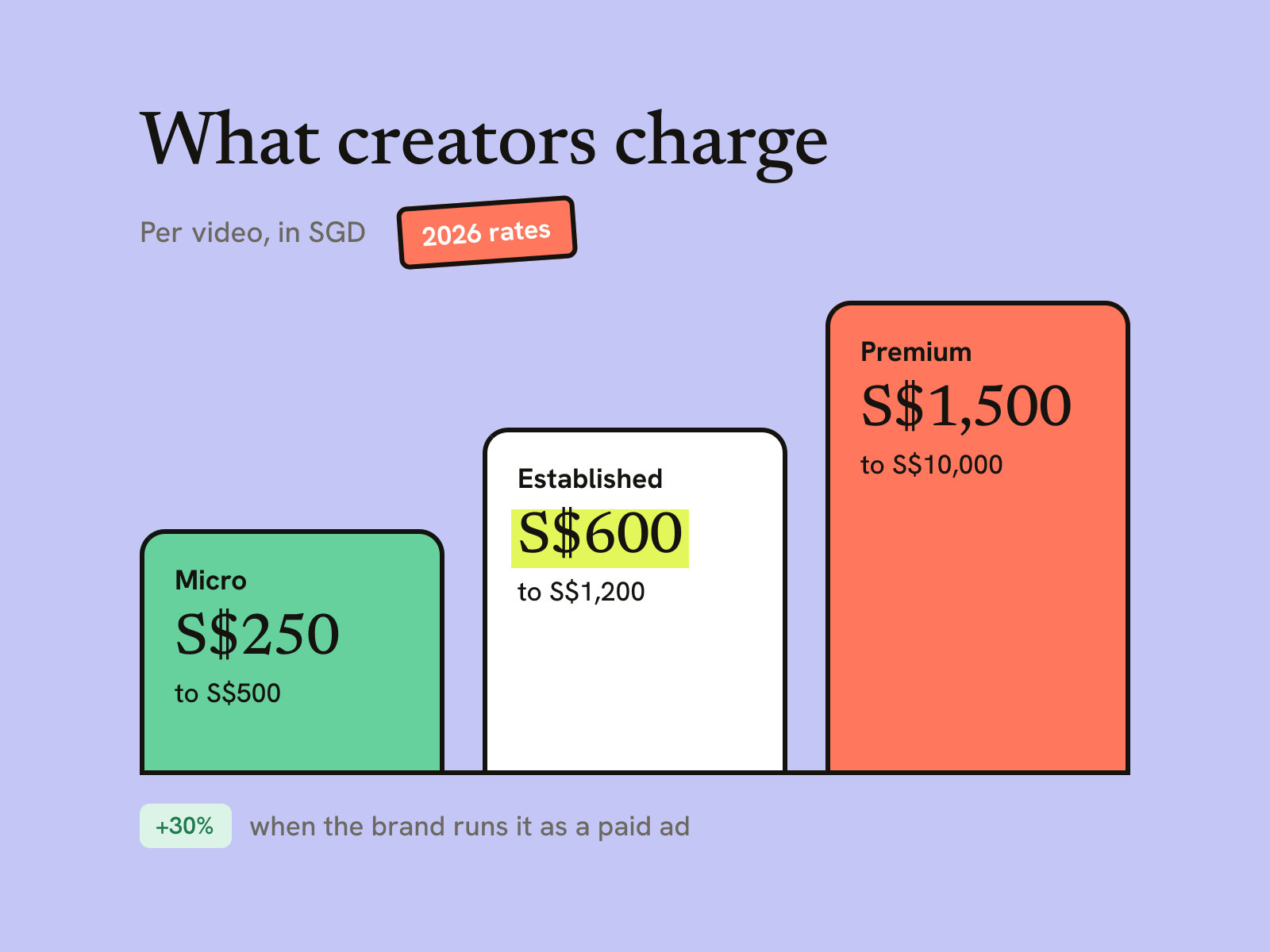
| One UGC video, organic use | S$250–S$500 micro, S$600–S$1,200 established (about US$190–US$380 and US$460–US$930) | Our creator rate bands (cost calculator) |
| One sponsored post, nano (1K–10K) | $25–$150 on Instagram, $5–$200 on TikTok | Shopify's 2026 pricing guide |
| Whitelisting on top of a video | +30% to +50% of base | Later's 2026 benchmarks |
| Starter retainer, four videos a month | $800–$1,500 | JoinFlare's retainer packages |
The money is moving toward smaller creators. In the Influencer Marketing Hub 2026 benchmark report, 87.49% of surveyed marketers expect their influencer budget to increase in 2026, and 72.22% expect it to rise by 50% or more. That same report shows roughly 80% of the cost ranges reported for UGC creators sitting under $500, with nano and micro creators the most budgeted-out tiers. For the regional picture, how much influencers make in APAC, with 2026 data sets out the local numbers.
Why do the published rate guides disagree?
Pick up three 2026 rate guides and you get three answers for the same creator. Nobody is lying. They measure different things, and knowing which thing decides which number you quote from.
- Different tier boundaries. Hootsuite counts micro as 10K to 50K followers and puts an Instagram micro post at $200 to $2,000. Shopify counts micro as 10K to 100K and puts it at $250 to $5,000. Later uses 10K to 100K and says $500 to $2,500. One label, three definitions, three bands.
- Different evidence. InfluenceFlow computes medians from creators' live rate cards, which are opening asks. Influencer Marketing Hub surveys marketers on the cost ranges they budget with. An ask and a budget are not the same measurement, and they will not land on the same figure.
- Different amounts bundled in. A $150 video with organic posting is not the same product as a $150 video with a year of paid advertising attached. Guides differ on whether the licence sits inside the headline number or stacks on top of it.
- Different honesty levels. Some tables publish medians with sample sizes, some publish model outputs with the formula shown, and some publish a rounded range with no method attached. The table with the methodology note is the one to argue with.
How much does a UGC video pay compared with a sponsored post?
The two are priced on different logic, and mixing them up is how a creator ends up quoting $90 for a job that should have been $400.
A UGC video is bought as an asset. The brand shoots nothing itself, buys your file and the licence to use it, and never needs your audience. Price it per deliverable: length, edit, revisions, rights. On our own rate bands, a micro creator's UGC video is S$250 to S$500 (about US$190 to US$380), and an established creator's is S$600 to S$1,200 (about US$460 to US$930). Paid usage adds about 30% on top.
A sponsored post is bought as reach. Your audience is the product, so follower count and engagement do the pricing. Shopify puts a nano Instagram post at $25 to $150 and a nano TikTok video at $5 to $200, with micro creators at $250 to $5,000; Hootsuite puts nano at $20 to $200 on Instagram. The floor is low and the ceiling is wide, because the audience is what varies.
Which one you are being offered is usually clear from the brief. If they want footage for their own channels and ad account, it is a UGC deal. If they want it on your handle, seen by your followers, it is a post, and it should be quoted from the post table.
How much do brands pay for whitelisting and usage rights?
Usage is the line that doubles invoices. A base fee covers organic posting on the brand's own channels. Anything past that is a licence, and the 2026 guides agree on the shape even where they disagree on the size.
- Paid ads for 30 days: about +30% of the base fee
- Paid ads for 90 days: about +50% of the base fee
- Whitelisting, where the ads run from your handle: two different pricing shapes, set out below
- Perpetual buyout: quote per campaign, or decline
The paid-ad figures come from the conventions Framekit's guide collects, and Later independently puts usage rights at 30% to 50% of base. Where two separate guides land on the same shape, you can quote it without feeling like you made it up.
Whitelisting is where the guides split. Later treats it as a flat add-on of 30% to 50% of the base fee for the whole campaign. Framekit treats it as a monthly licence instead, following the Influee and ppc.io conventions it cites: about 30% of base per month, with the published range running up to 100% a month. Ask which shape they mean before you quote anything. Then ask for the access window in days and price it per month with an end date, because a flat 30% that never expires is the cheapest option for the brand and the worst one for you.
Whitelisting and paid usage are still two lines, not one. The licence lets them spend money against your footage. Whitelisting lets the ads run from your handle, which borrows your name as well as your video. Buying one and assuming the other is the common and expensive mistake. The mechanics are in usage rights for creators.
What does a monthly retainer pay?
A retainer is a fixed monthly fee for an agreed number of videos. Brands reach for it once a creator has worked for them, and it is where the per-video math changes.
JoinFlare's 2026 packages run $800 to $1,500 a month for four to six videos at the start, $2,000 to $3,500 for eight to ten, and $4,000 to $7,000 for 16 to 20. Creator Stamp's ranges sit lower for newer creators, at $500 to $800 for four videos, and higher for intermediate ones at $1,000 to $1,800.
The two disagree because they bundle different things: rights, revisions and commitment length are either inside the monthly number or priced on top. Both build the price the same way, from your per-video rate multiplied by the volume, then discounted for the commitment. JoinFlare sizes that discount at 15% to 25%; Creator Stamp puts it at 10% to 25%. On a $150 video at four a month, less about a fifth lands near $480 before any rights.
Build a retainer out of beginner per-video rates and you land under the published starter bands. That is worth noticing: retainer tables are written for creators who already have repeat clients, and the first retainer you are offered will usually be priced from your existing per-video rate rather than from a table.

Get paid for your audience. Know exactly what to charge.
A fair price, worked out for you, before the brand asks.
First deal not invoiced in 30 days? The founders sit with you until it is.
Try it free on your next deal14-day free trial · Cancel any time · We never take a commission
How do you place yourself inside these benchmarks?
Six steps. You can finish them in twenty minutes and use the result on your next reply.
-
Name the deal type first. Write down which of the four you have been offered, and whether rights are included. A number pulled from the wrong table is worse than no number.
-
Pick two sources that measure the same thing. Not two general rate guides: two that cover your deal type. Read the methodology line under each table before you trust it, because a survey of brand budgets and a median of creator asks will not match.
-
Find your tier and take the band, not the midpoint. Match your follower count or your experience to the tier, write down the low and the high, and plan to open near the middle of it. The band is the negotiation range, not one number to defend to the death.
-
Price rights as their own lines. Copy the conventions straight onto your quote: +30% for 30 days of paid ads, +50% for 90 days, and whitelisting as its own line with a stated access window. Separate lines turn a haggle about your worth into a decision about their licence.
-
Sanity-check the total against a calculator. The Creator Rate Calculator runs the same four lines: base, revisions, usage, extras. If your total lands outside every band you found, one of the two is wrong, and it is usually the line you forgot.
-
Send a number this week. Not the perfect number. A brand cannot negotiate with a guess, and your second quote will be better than your first because it will be based on a real response instead of a guess about a guess.
If you have no deals yet, the Starting Price Calculator in The Creator List gives you a starting price in your own currency before the first DM arrives, so you are not pulling a figure out of the air. It is a private workspace for brand deals you already have, with a 14-day free trial, then a monthly plan at pricing. Once the first few deals are in and you want to move your band up, how to raise your rates without losing clients is the next step.
Your one next action: write down a band from one deal type above, attach it to your next reply, and let the brand respond to a range rather than to your nerves.
Common questions
Our rate bands put a micro creator's UGC video at S$250 to S$500 (about US$190 to US$380) and an established creator's at S$600 to S$1,200 (about US$460 to US$930), for organic use. Paid usage adds about 30%.
Rate guides measure different things. Some survey marketers on the budgets they use, some compute medians from creators' live rate cards, and some publish a model with the formula shown. Tier labels also differ: micro means 10K to 50K followers in one guide and 10K to 100K in another, so the same word covers different creators.
No. The base fee covers organic posting on the brand's own channels, and paid ads and whitelisting are separate licences. Later prices whitelisting as a flat 30% to 50% of base for the campaign, while Framekit prices it as a monthly licence at about 30% of base per month, so the access window has to be agreed before either number means anything.
Follower counts decide reach deals, not content deals. A UGC video sold for its footage is priced per deliverable, so a creator with 800 followers quotes the same ladder as one with 20,000. Follower count starts to matter once the brand is buying your audience as well as your work.
Get paid for your audience. Know exactly what to charge.
A fair price, worked out for you, before the brand asks.
First deal not invoiced in 30 days? The founders sit with you until it is.
Try it free on your next deal14-day free trial · Cancel any time · We never take a commission
Read next
 Brand Deal Rates for 10k Followers: What to ChargeWhat to charge for a brand deal at about 10k followers: the band to start from, the seven things that move you inside it, a worked example and a message to send.
 How Much Do Influencers Charge in Malaysia? 2026 GuideIndicative RM benchmarks from published sources, the difference between reach and content, and a scope checklist for comparing Malaysian creator quotes.
 UGC Creator Rates in Singapore (2026 Price List)Indicative Singapore UGC rate bands, the scope and rights questions behind every quote, and a practical method for comparing creators fairly.
 How Much Does It Cost to Hire a Creator? SG Rates 2026The honest 2026 cost of hiring a creator in Singapore: organic posts, UGC videos and advertising rates by scope, the add-ons that move the price, and how to hire without getting burned.