How Do Influencers Make Money: 7 Income Streams Ranked
Seven income streams for influencers, ranked by how fast each pays: brand deals first, then usage rights, UGC, retainers, affiliate links, own products and platform payouts last.
 Written by Jack Evans4 min read

How do influencers make money? Brand deals are the core stream, and the reliable ones stack several more on top: usage rights sold with every deal, UGC made without posting, retainers, affiliate links, their own products and platform payouts last. Seven streams, ranked by how fast each one pays.
On this page
How do influencers make money? Brand deals are the core stream, and the reliable ones stack several more on top: usage rights sold with every deal, UGC made without posting, retainers, affiliate links, their own products and platform payouts last. Seven streams, ranked by how fast each one pays.
An influencer is someone brands pay to make content or share it with an audience, and the income is the sum of those payments rather than the follower count itself. So a small creator with a clear niche and proof content regularly out-earns a larger account with no offer.
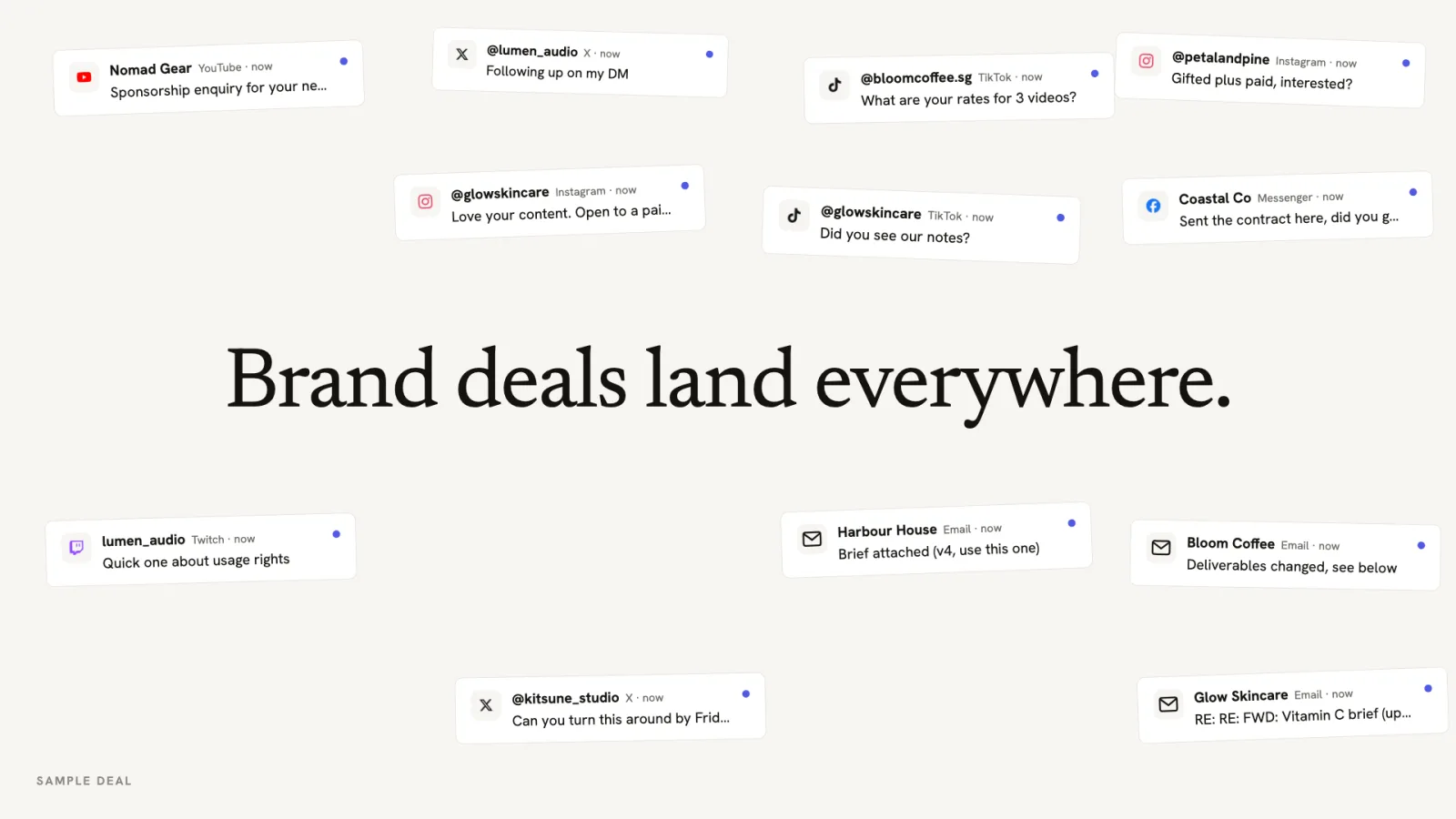
The income arrives from several directions at once, which is the whole point of stacking streams.
What do you need before any of it pays?
Four things, all free. None of them is a follower milestone, however:
- Two or three pieces of proof content. One honest review, one product-in-use clip, one result. This is the portfolio every stream on the list is bought against.
- A rate you can say out loud. The Creator Rate Calculator gives a starting number in your own currency, and the rate card guide shows how to present it as one link.
- A way for brands to reach you. An email in every bio, and the pitch guide covers the first message that gets a reply.
- One place tracking every deal. Streams multiply fast; a single row per deal in the brand deal tracker guide keeps the payment dates from scattering.
How do influencers make money in practice?
Seven streams, ordered from the fastest real payment to the slowest to build. The first two carry most creators, so treat the rest as months-away extras that stack on top. This guide covers where the money comes from; for what creators actually earn by tier and market, see how much influencers make in APAC.
-
Brand deals: the core stream. A brand pays for a specific format, posted to the creator's own audience. This is where almost every influencer income starts, and where the pricing rules matter: scope, revision rounds and payment terms go in writing, and the contract template covers all three.
-
Usage rights and paid ads: the upsell on every deal. The same video is worth more when the brand keeps using it. Organic posting is the base fee; paid usage is priced by how long the brand runs the ad, at roughly 30% of the fee for a 30-day window and more for 90 days or longer. The usage rights guide prices each permission.
-
UGC: get paid to make content you do not post. Brands buy videos to run on their own channels, so the creator's own follower count never enters the deal. The work is the same as a brand deal minus the posting, and the UGC cost calculator sizes a first batch.
-
Retainers: turn one-off deals into monthly income. A brand that bought three videos this quarter is a brand that can approve a fixed monthly slot: two videos a month, invoiced on the same date every month. Retainers smooth the gap between deals, so extra rounds need boundaries in writing; the scope creep guide draws that line.
-
Affiliate links: income from content that already exists. A commission on sales driven through a tracked link. Per sale it is small, but the content keeps earning after posting, so it keeps paying while the creator moves on to the next video. TikTok Shop is the built-in version of this on TikTok.
-
Your own products: templates, presets, guides. Once the audience asks the same question in the comments, the answer can be a product. Margins are the best of any stream here, and the build takes weeks rather than an afternoon.
-
Platform payouts: last for a reason. Ad-revenue shares and creator bonus programmes exist, and they are real money, however rates shift without notice and rarely beat a single brand deal. Treat whatever a platform pays as the topping, never the meal.
What mistakes stop influencer income growing?
- Treating the follower count as the income. Brands buy format, fit and reliability, so a count with no proof content behind it is the first thing a brand scrolls past.
- Counting free product as pay. PR packages are marketing, not money, and they do not pay rent; the PR packages guide explains what they are actually worth. A 2022 Tipalti survey reported by Business Insider found that 87% of creators had been paid late, paid the wrong amount, or not paid at all, which is a problem only real invoices can have.
- Quoting an organic rate for ad usage. A brand that will run the video as an ad is asking for a different product at a different price. Name the usage term and the fee together, never afterwards.
- Letting the streams scatter. Four streams across four spreadsheets and a DM inbox means missed invoices. One tracker, every deal, every due date.

More deals. Less admin. Paid on time.
Every deal on one page, invoices out on time, reminders written for you.
First deal not invoiced in 30 days? The founders sit with you until it is.
Try it free on your next deal14-day free trial · Cancel any time · We never take a commission
When does this income actually arrive?
The honest timeline: nothing lands by Friday, so plan on weeks of pitching for the first brand deal rather than days. After the yes, Digiday reported in 2024 that influencer payment terms typically run 30 to 90 days after the work is done, so treat the first paid invoice, not the first yes, as the milestone. The stack builds stream by stream: the second usually arrives within a couple of deals, and the slower ones in the list need an audience that already trusts the recommendation.
When two or three streams are live, the admin starts competing with the creating: invoices, usage expiries, affiliate dashboards, each with its own dates. The creator tools page shows what a workspace adds at that point: the brief, agreement, drafts, approval and invoice on one record, with the client joining free from your link. Try it on your next deal with the 14-day free trial, then a monthly plan, with prices on the pricing page.
Common questions
Influencers without a huge audience make money from fit rather than reach: micro creators in one niche charge for brand deals, sell UGC to brands that need content without posting it, and earn affiliate income from the products they already recommend. Brands paying for a specific format to a specific audience rarely shop by follower count alone.
Brand deals and UGC are priced per video by scope, with paid usage priced on top by duration: about 30% of the fee for a 30-day ad window and more for longer ones. Retainers are a monthly fee, affiliate links pay a commission per sale, and own products keep the margin. Earnings by creator tier and market are in the APAC influencer pay guide.
The first brand deal is usually the fastest route to a real payment, because it needs only a pitch and a format. Affiliate links are the easiest add-on afterwards, since they drop onto content that already exists. UGC sits between the two: it pays without requiring the creator's own posting schedule, once a portfolio of two or three samples exists.
Some platforms pay creators directly through ad-revenue or bonus programmes, but those payouts are the smallest and least stable stream. Platform terms change without notice, so creators who build on payouts alone stay exposed. Brand deals priced by scope and usage remain the income a creator controls, which is why they sit first in every reliable stack.
More deals. Less admin. Paid on time.
Every deal on one page, invoices out on time, reminders written for you.
First deal not invoiced in 30 days? The founders sit with you until it is.
Try it free on your next deal14-day free trial · Cancel any time · We never take a commission
Read next
 How to Become a UGC Creator in Australia (2026)A practical path to becoming a UGC creator in Australia: no following required, how to build a portfolio, land paid brand work, and what to charge.
 How to Become a UGC Creator in Singapore (2026)A practical guide for aspiring UGC creators in Singapore: what the role involves, gear you need, how to build a portfolio, set rates in SGD, and land and manage your first paid briefs.
 How Much Do Influencers Make in APAC? (2026 Data)2026 APAC influencer earnings by reach tier and platform in local currencies, plus why licences decide what a creator really makes.
 How to Choose a Social Media Agency in SingaporeWhat a social media agency in Singapore actually does, what it costs, and when booking a vetted creator direct beats a full retainer.