Creator Rate Card Template for UGC Deals (2026 Guide)
A creator rate card template that separates content fees from usage licences, with package tiers, S$ benchmarks and negotiation notes.
 Written by Jack Evans6 min read

A creator rate card is a one page menu a creator sends after a brand says yes: content fees separated from usage licences, package tiers for one, three and six videos, and the terms that apply to every line. Price the content once, price the licence by window, and date every figure. In 2026, dated cards beat vague promises.
On this page
A creator rate card is a one page menu a creator sends after a brand says yes: content fees separated from usage licences, package tiers for one, three and six videos, and the terms that apply to every line. Price the content once, price the licence by window, and date every figure. In 2026, dated cards beat vague promises.
Why does a rate card win better deals?
Without a card, every quote is improvised. Improvised quotes drift with mood, urgency and how much the creator wants the deal. One brand pays S$1,800 (about US$1,400) for a Reel plus licence, the next pays S$1,200 (about US$930) for the same bundle, and the archive proves nothing because no two quotes share a structure.
The market confusion is real. Singapore community answers on creator pricing range from a few hundred to low five figures SGD, as threads on Reddit r/askSingapore show, and published guides swing from S$50 (about US$40) nano posts to S$10,000 (about US$7,750) plus macro posts. A dated card cuts through that noise with one page: these formats, these packages, these licence windows, valid until this date. How much brands pay creators in 2026 has the wider ranges, and the UGC creator rates price list for Singapore breaks the bands down by tier.
Late payment data adds the second reason. A survey reported by Business Insider found that 87% of creators had been paid late, paid the wrong amount, or not paid at all. Cards that state deposit, net terms and late fees upfront get paid on schedule. Quotes that hide terms chase for months across the 30 to 90 day windows that Digiday reports as standard.
What should a creator rate card include?
Six blocks build the page. Copy them in order, fill the brackets, date the footer.
- Content fees by format. One line per format with length and platform. Example: 1 Reel 9:16 30 to 45 seconds, S$1,200 (about US$930); 1 TikTok plus 3 Stories, S$1,100 (about US$850); 3 Stories with link sticker, S$300 (about US$230).
- Package tiers. One, three and six video bundles with a volume curve. Example: 1 video S$1,200 (about US$930); 3 videos S$3,200 (about US$2,500); 6 videos S$6,000 (about US$4,650). Tiers turn haggling into upselling: the brand climbs the menu instead of cutting the line.
- Usage licence lines. Separate rows by window, priced apart from production. Example: 90 day Spark Ads S$600 (about US$460); 12 month organic S$300 (about US$230); buyout on request. The usage rights guide carries the full pricing ladder behind these rows.
- Revision and reshoot terms. Two rounds included per deliverable, S$150 (about US$120) per extra round, reshoots quoted per day. Terms written on the card need no fresh negotiation mid deal.
- Payment terms. 50% deposit before filming, balance net 14 after delivery, 1.5% monthly late fee. In Singapore, the ASAS guide disclosure duty sits beside payment in the footer, so compliance travels with the money terms.
- Validity date. Rates valid until 31 Dec 2026. Dated figures expire gracefully. Undated figures live forever as screenshots.
Michael Collins (@bigchunkks) runs high volume challenge and comedy formats: 61.5K followers across platforms, 733K average views on his best-performing posts and a single reel past 9.7M views. When formats repeat across brands, a dated card keeps his tenth quote as clean as his first. If a brand offers free product in place of a fee, gifted vs paid collabs helps you decide before you quote.
How do you build package tiers that sell?
Three tiers beat ten options. Anchor the middle, discount the top lightly, and let the brand climb. For when a bundle earns a discount and when it should not, see UGC bundle pricing. If you are setting your first per-video number, brand deal rates at 10k followers shows where to start.
- Price the single first. Cost one video honestly: shoot time, edit time, revision buffer, platform posting. The single is the anchor every other figure derives from.
- Bundle three at a small curve. Three videos at roughly 90 percent of three singles. Example: S$1,200 (about US$930) single becomes a S$3,200 (about US$2,500) triple. The brand saves a little, the creator books a month.
- Bundle six as the retainer bridge. Six videos at roughly 85 percent of six singles, delivered across two to three months. The six pack is the waiting room for a retainer, packaged later as monthly deliverables with renewal terms.
- Licence every tier separately. Packages discount production, never licences. Usage windows price per video per window regardless of tier, so volume never eats renewal revenue.
Which mistakes break a creator rate card?
- One blended price. A single figure hides the licence and kills renewals. Split content and usage on every tier.
- Too many options. Twelve formats invite cherry picking. Three packages invite decisions.
- No validity date. Undated cards get screenshotted and quoted back a year later. Date every version.
- Discounting the licence. Volume curves apply to production. Licences price per window, every time.
- Hiding payment terms. Cards without deposit and net terms quote prices but promise nothing. Terms on the card become terms in the contract template without argument. If you want a tool to hold that wording, influencer contract template apps compare three routes.
- Quoting in bare numbers. A bare 1,800 across SGD, MYR, THB, HKD, AUD and IDR rows starts an argument. Write S$1,800 (about US$1,400) or RM2,400 (about US$560) on every line.
- Negotiating against yourself. Sending three successive discounts teaches the brand to wait. Send the card once, then let silence and the scope creep guide do the rest.
What are the key takeaways?
- Send the card after the brand says yes, at briefing stage.
- Split content fees from licence fees on every line and tier.
- Sell one, three and six video packages with a light volume curve.
- Licence per video per window, never discounted with volume.
- Date every card and review figures quarterly.
- State deposit, net terms and late fees on the page itself.
A clean card footer looks like this: rates valid until 31 Dec 2026, 50% deposit before filming, balance net 14, 1.5% monthly late fee, two revision rounds included. Five facts that turn prices into terms.

Get paid for your audience. Know exactly what to charge.
A fair price, worked out for you, before the brand asks.
First deal not invoiced in 30 days? The founders sit with you until it is.
Try it free on your next deal14-day free trial · Cancel any time · We never take a commission
How does The Creator List workspace replace rate chaos?
The card is a menu. The workspace is the kitchen that serves it: capture, brief, contract, delivery, sign-off. When quotes, licences and payments share one roof, the card stays honest. If a brand asks for your media kit as well, the media kit vs rate card guide explains which one goes first.
The Creator List is a private workspace for the brand deals you already have. The Starting Price Calculator and a rate card in your local currency give you a first number, and the brief guide explains each field (fee, usage, payment terms, feedback rounds) with typical rates. Once a deal comes in, the package agreed at briefing becomes the real pieces of work, with drafts, client notes and approvals in the same deal, and the invoice follows your country's rules, with payment reminder drafts you send yourself. It isn't a marketplace. We don't find work or introduce you to brands, and the money goes straight between you and your client, with no fee on what they pay you.
It starts with a 14-day free trial that covers one real deal, then a monthly plan; see pricing. If you would rather manage won deals where the package, the licence and the invoice share one roof, create your account. If you prefer the manual route, keep this card and the guides hub beside it.
Common questions
A creator rate card is a one page menu a creator sends after a brand says yes, listing content fees separated from usage licences, package tiers for different video counts, and the payment and revision terms behind every line. The card turns rate questions into package choices.
A UGC rate card should include per format content fees, package tiers for one, three and six videos, usage licence lines by window, revision rounds, payment terms with deposit and net terms, and an expiry date for the figures. Each line answers one brand question: what it costs, what is included, and how long the price holds.
Creators should separate content fees from usage fees by listing production lines first and licence lines second, each with its own figure. A S$1,200 (about US$930) video plus a S$600 (about US$460) 90 day Spark licence reads as two purchases, while a single S$1,800 (about US$1,400) line hides the renewal value and kills future extensions.
Creators should update their rate card every quarter, or whenever average views move a full tier. Dated figures with a valid until line keep old screenshots from haunting negotiations, and quarterly reviews keep package tiers matched to current demand.
Creators should share their rate card after a brand says yes, not on a public profile. Sending the card at briefing stage frames the conversation around packages instead of discounts, while a public card invites bargain hunting before the brand understands the usage maths.
Get paid for your audience. Know exactly what to charge.
A fair price, worked out for you, before the brand asks.
First deal not invoiced in 30 days? The founders sit with you until it is.
Try it free on your next deal14-day free trial · Cancel any time · We never take a commission
Read next
 Influencer Media Kit Template for Creators (2026 Guide)A two page influencer media kit template with demographics, engagement proof, past work, rates and usage terms for won deals.
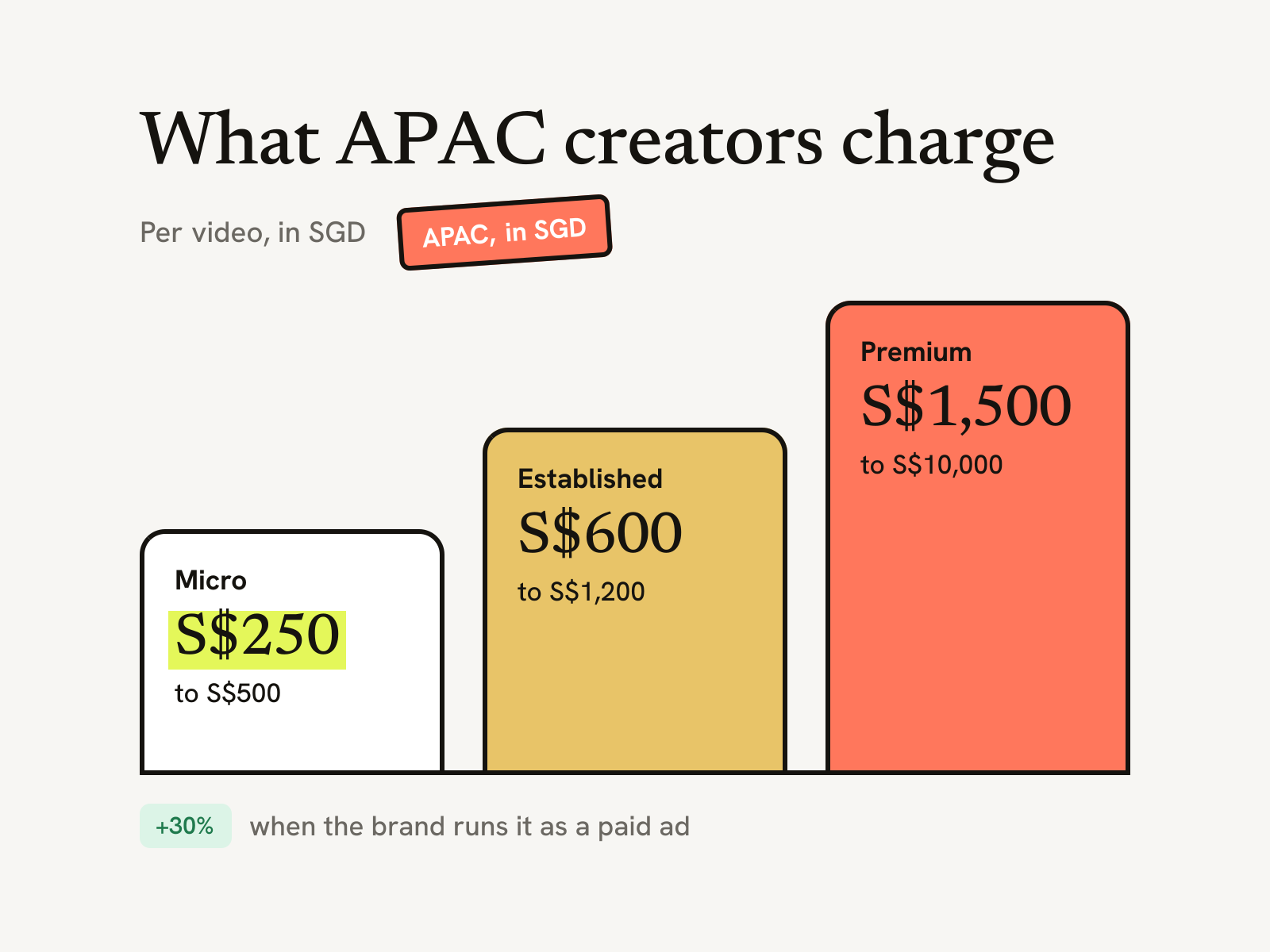 UGC Creator Rates 2026: What APAC Creators ChargeLocal-currency UGC and influencer rate bands across seven APAC markets, the reach versus content distinction that fixes mispriced briefs, and the usage-rights line that inflates budgets.
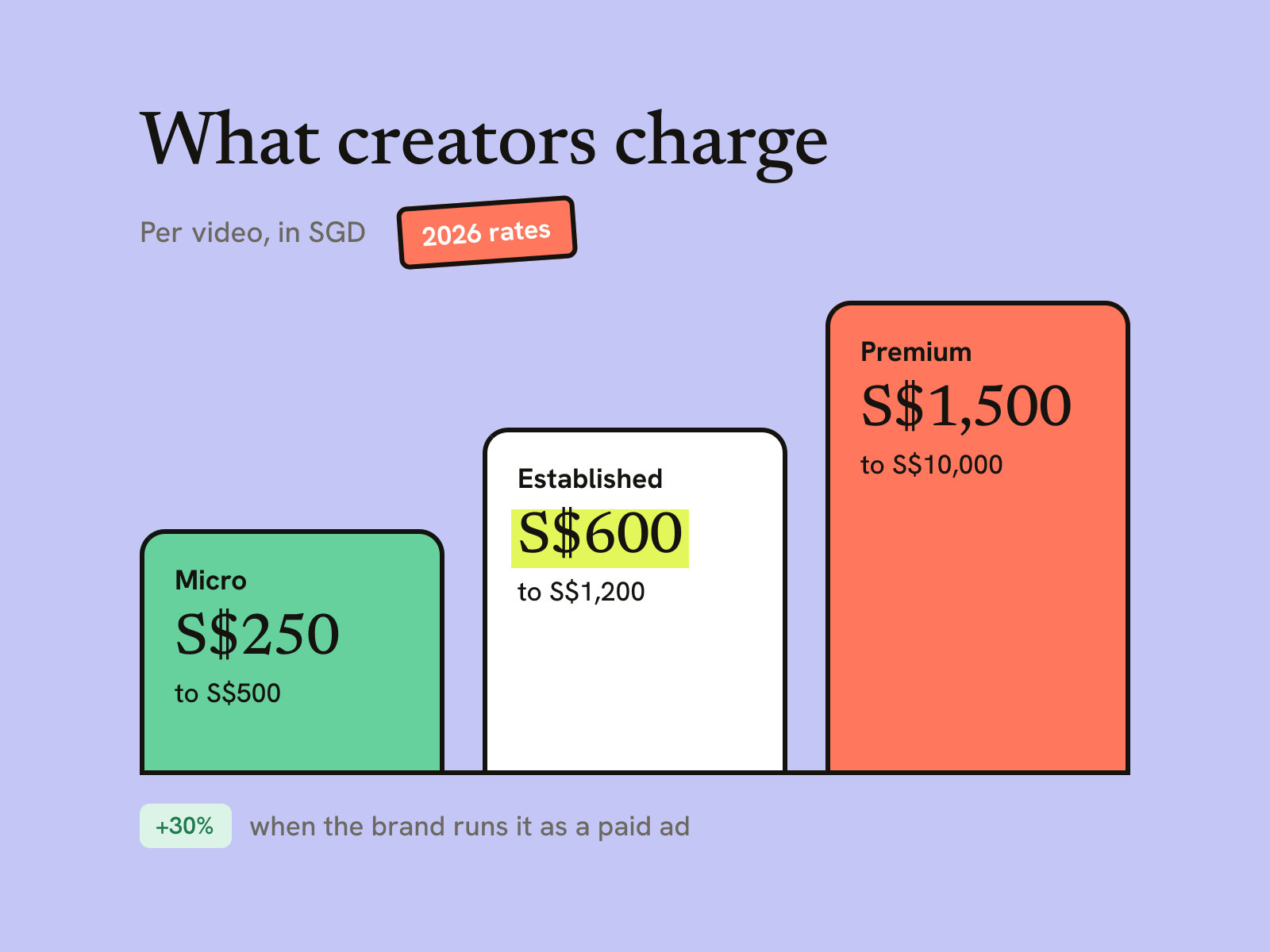 How Much Does It Cost to Hire a Creator? SG Rates 2026The honest 2026 cost of hiring a creator in Singapore: organic posts, UGC videos and advertising rates by scope, the add-ons that move the price, and how to hire without getting burned.
 How Much Do Influencers Make in APAC? (2026 Data)2026 APAC influencer earnings by reach tier and platform in local currencies, plus why licences decide what a creator really makes.