How to Invoice a Brand as a Creator (2026 Guide)
A creator invoicing guide with the line items brands expect, payment terms that get paid, late fees, usage rights charges and cross-border notes.
 Written by Jack Evans6 min read

Learning how to invoice a brand means sending a numbered invoice on the trigger date with your details, the brand details, one line per deliverable, usage rights as its own line, the fee, payment terms and a late fee. Match every line to the agreement and chase once at net terms plus seven days, so delivered work becomes scheduled money.
On this page
Learning how to invoice a brand means sending a numbered invoice on the trigger date with your details, the brand details, one line per deliverable, usage rights as its own line, the fee, payment terms and a late fee. Match every line to the agreement and chase once at net terms plus seven days, so delivered work becomes scheduled money.
Why does invoicing decide whether a won deal pays?
Delivery earns the money. The invoice collects it. Between those two moments sits brand finance, a queue of vendors, and payment terms that run long. In 2026, Digiday reports that influencer payment terms typically run 30 to 90 days after the work is done. An invoice sent late starts that clock late. An invoice with missing lines restarts it.
The cost of weak invoicing is documented. A survey reported by Business Insider found that 87% of creators had been paid late, paid the wrong amount, or not paid at all. Most of that is process failure: no invoice number, no due date, no named contact, no follow-up date. Finance teams pay complete invoices first and query the rest.
Proof beats size. Kelicia Ong (@kelifries) has 18.3K followers and a top TikTok at 1.2M views, about 66 times her follower count, and her invoices list exact deliverables and separate licence lines, so a brand pays for the work and the rights it can see. Engagement quality wins the deal. Invoice quality collects it.
What do you need before you invoice a brand?
Gather four things before you type the invoice. Each one becomes a field on the page. Not sure whether you need a company name on it? Do you need a business to do brand deals? covers what brands ask for.
- The signed agreement. Deliverables, fee, currency, deposit, net terms, late fee, invoice trigger. Every invoice line mirrors this page. If the trigger says posting date, the invoice goes out on posting day, not a week later.
- Posting proof. Live links, screenshots with disclosure tags visible, Spark Ads start dates. Finance releases money faster when the proof rides with the invoice.
- Brand billing details. Company name, billing email, contact person, purchase order number where one exists. Creators who invoice a generic info@ address wait longer than creators who invoice a named person.
- Your payment details. Legal name, bank account or payment handle, currency, tax registration where applicable. In Singapore, IRAS expects businesses to keep proper invoice and payment records for at least five years, so number every invoice and keep every receipt.
How do you invoice a brand without errors?
Work these five steps in order. Each step fills one part of the invoice, and the page is ready to send when the last one is done.
- Confirm the trigger. Check the agreement for the invoice date: delivery, posting, or a split such as 50% before filming and 50% on posting. Send on that date. The contract template sets this date at signing, so invoicing day is never a guess.
- Build the line items. Write one line per deliverable with format, platform and date: 1 Reel 9:16 posted 5 Oct, S$1,200; 3 Stories with link sticker, S$300; 90 day Spark Ads licence, S$600. Separate production from licensing on the page so renewals have a price to point at later.
- Add terms and the late fee. State net 14 or net 30, the exact due date, and the late fee, for example 1.5% per month after the due date. Restate the deposit already received and the balance now due. Terms copied from the agreement need no fresh negotiation. What to write for that fee is covered in late payment fee invoice: what creators can charge.
- Send with proof attached. Email the PDF to the named billing contact with the invoice number in the subject line, attach posting proof, and keep the body to three lines: what is attached, the amount, the due date. Copy the brand contact from delivery so nothing hides in DMs.
- Chase on schedule. Diary one chase at net terms plus seven days: reattach the invoice, restate the due date, stay short. Late invoice scripts carry the exact wording, so the chase stays calm and scheduled instead of emotional.
Which mistakes delay creator invoices?
- Invoicing late. Every day of delay pushes the due date and the chase by a day. Invoice on the trigger date, even on a Friday.
- One lump sum line. A single S$2,100 (about US$1,650) line invites finance queries. Itemised lines get approved. Split deliverables, licence and extras.
- Hiding usage rights inside the content fee. When the licence has no line, the brand assumes it was included. Give usage its own line with platforms and duration every time.
- No invoice number. Numbers make the invoice trackable on both sides. Date based sequences such as 2026-014 cost nothing and prevent duplicate payment confusion.
- Wrong currency or missing conversion note. A bare 1,800 across SGD, MYR, THB, HKD, AUD and IDR rows starts an argument. Write S$1,800 or RM2,400, and name who absorbs transfer fees on cross-border deals.
- Sending the invoice only by DM. Message threads bury attachments. Email the PDF to a named billing address, then link it from the deal tracker beside the delivery and payment due dates.
- Chasing without the attachment. A chase that says pay me without reattaching the invoice creates a new round of searching. Every chase carries the invoice again.
What are the key takeaways?
- Invoice on the contract trigger date, not when it feels convenient.
- Itemise every line: deliverables, licence, extras, deposit received, balance due.
- State net terms, an exact due date and a late fee copied from the agreement.
- Attach posting proof and email a named billing contact.
- Chase once at net terms plus seven days with the invoice reattached.
- Keep one currency per invoice and record every number for tax time.
A clean invoice looks like this: Invoice 2026-014, Glow Lab SG, 1 Reel posted 5 Oct S$1,200 plus 90 day Spark licence S$600, less 50% deposit received, balance S$900 due 19 Oct, 1.5% monthly late fee. Six lines, one amount, one date.

More deals. Less admin. Paid on time.
Every deal on one page, invoices out on time, reminders written for you.
First deal not invoiced in 30 days? The founders sit with you until it is.
Try it free on your next deal14-day free trial · Cancel any time · We never take a commission
How does The Creator List workspace replace invoice chasing?
Invoicing is the tail of a workflow: capture, brief, contract, delivery, sign-off. When delivery, approval and payment share one roof, the invoice writes itself from agreed lines.
The Creator List is a private workspace for the brand deals you already have: bring a deal in, then keep the brief, agreement, drafts, client review, invoice and payment follow-up in one place. Milestones hold the drafts and your client's notes and approvals, so proof sits beside the deliverable it proves. Invoices follow your country's rules (VAT for the UK, UEN for Singapore) and go out by email from the app, and payment reminder drafts are ready for you to send yourself. Creators who outgrow extra scope mid deal use the scope creep guide to reprice before the invoice, not after.
It isn't a marketplace. We don't find work or introduce you to brands, and the money goes straight between you and your client, with no fee on what they pay you. If you would rather manage won deals where the agreement, the proof and the payment share one roof, create your account: 14 days, then a monthly plan (see pricing). If you prefer the manual route, keep this guide and the guides hub beside it. See the work of featured Singapore creators for the standard this paperwork protects.
Common questions
A creator should invoice a brand on the trigger date named in the signed agreement, usually the delivery date or the posting date. Invoicing on time starts the net terms clock immediately, while waiting a week simply moves every later date, including the chase, a week later.
A creator invoice should include a unique invoice number, the issue date, creator and brand details, one line per deliverable with format and date, usage rights as a separate line, the fee in local currency, payment terms, a late fee and payment details. Each line should mirror the signed agreement so finance can approve it without questions.
Creators charge late fees by writing the fee into the contract first, then restating it on the invoice, for example 1.5% per month after net 30. A fee agreed upfront reads as a term the brand accepted, while a fee invented during the chase reads as a penalty and gets ignored.
Creators invoice across currencies by quoting, invoicing and recording in one stated currency per deal, for example S$1,800 or RM2,400, and naming who absorbs conversion and transfer fees. One currency per invoice keeps the tracker, the tax records and the chase free of exchange rate arguments.
More deals. Less admin. Paid on time.
Every deal on one page, invoices out on time, reminders written for you.
First deal not invoiced in 30 days? The founders sit with you until it is.
Try it free on your next deal14-day free trial · Cancel any time · We never take a commission
Read next
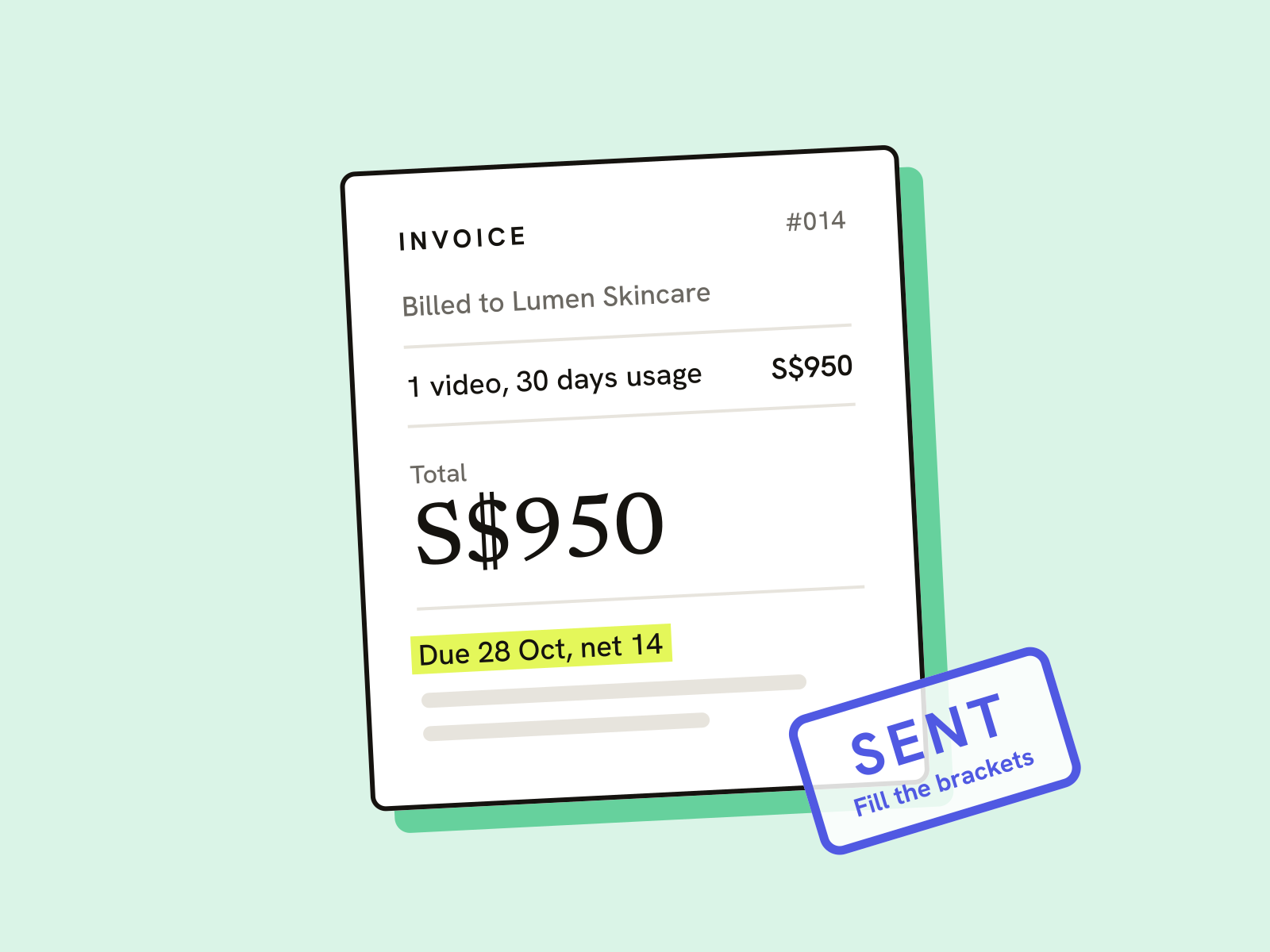 UGC Creator Invoice Template for Creators (2026)A copy ready UGC creator invoice template with editable deliverable, usage rights, payment term and late fee fields, plus how to fill each one.
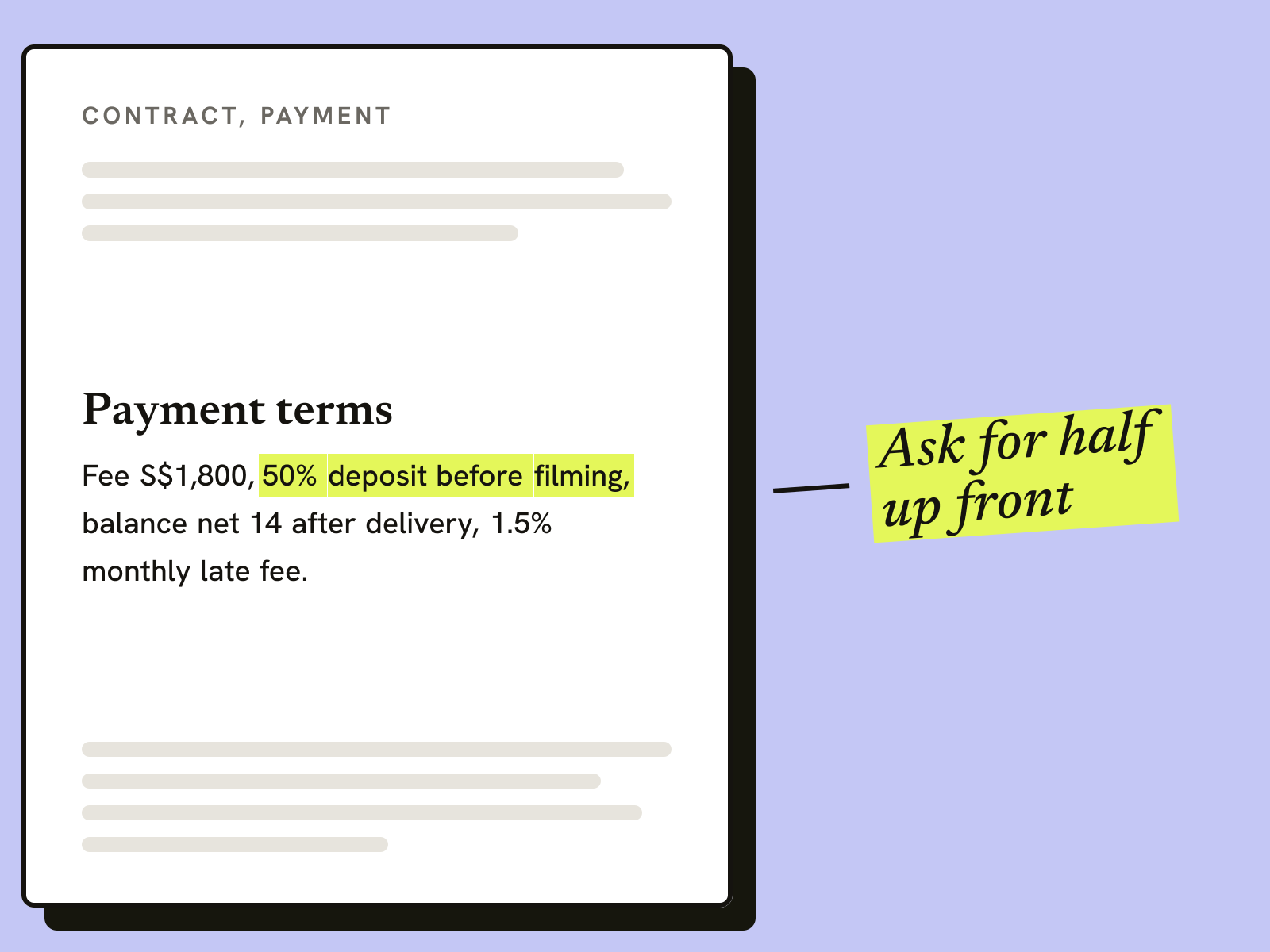 Brand Deal Contract Template for Creators (2026 Guide)A plain language brand deal contract template with six clauses that protect won deals, plus how to fill each field before work starts.
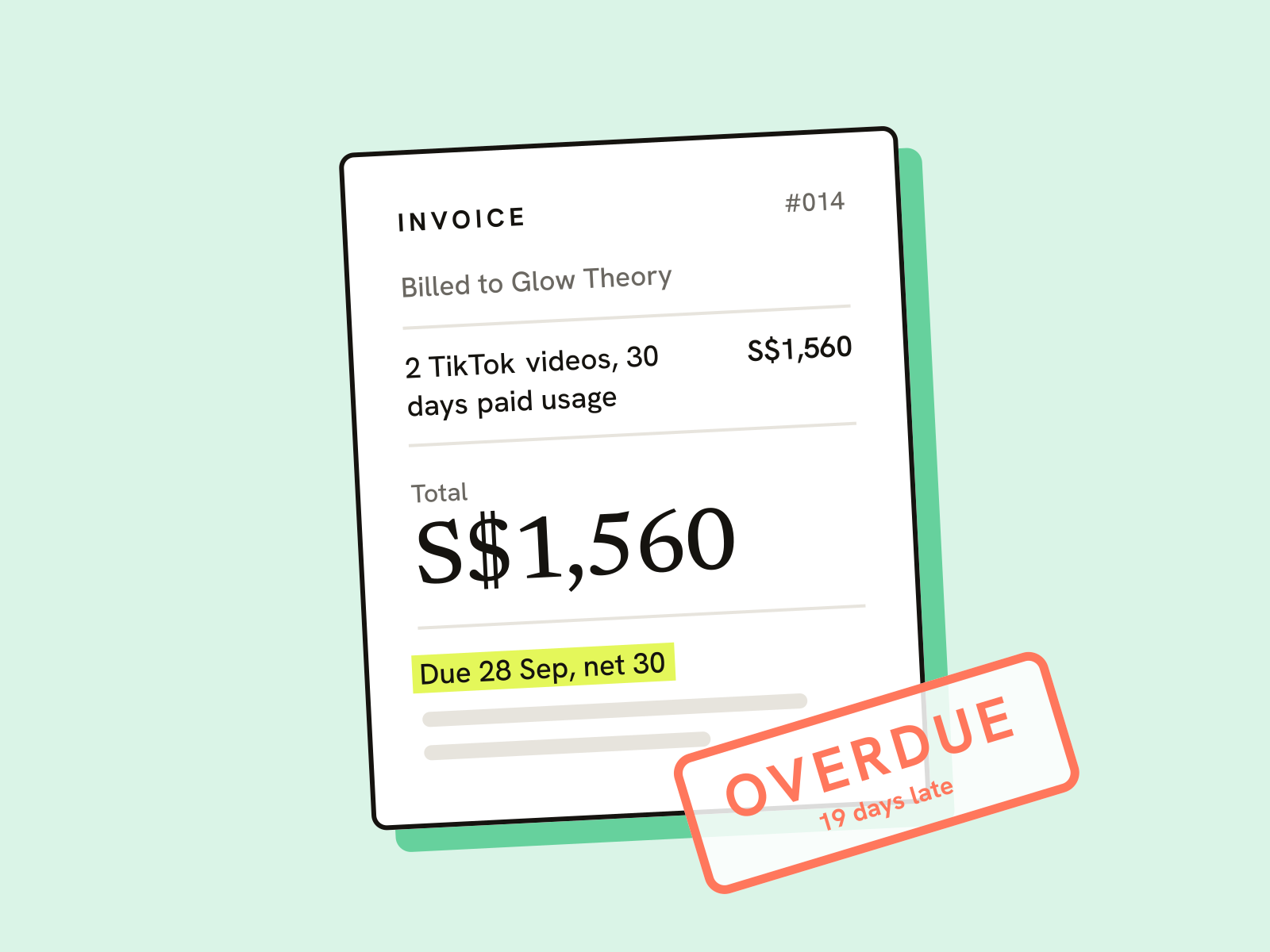 How to Follow Up on a Late Invoice: Creator ScriptsA three-stage process for chasing a late invoice as a creator: set the right terms first, send a polite nudge, a firm chase and a final notice, then escalate if needed.
 Influencer Media Kit Template for Creators (2026 Guide)A two page influencer media kit template with demographics, engagement proof, past work, rates and usage terms for won deals.