Agreement Short Form Clauses Brands Need
The one-page agreement for a single creator video: the eleven rows to fill, how to price usage separately from the fee, and when a short form should become a longer contract.
 Written by Jack Evans13 min read

An agreement short form is a one-page record of the terms that decide whether a creator video can be delivered, approved and paid without argument. For a brand, the rows that matter most are usage, revision rounds and the named approver, because those are what get disputed after filming.
On this page
You agreed a video on WhatsApp, and now the creator asks whether paid ads were included. You thought so; she thought she sold one organic post. That's a paperwork problem, and one page fixes it before anyone films.
What a Binding Agreement Short Form Covers
Say you're a founder selling a sauce you want filmed at a hawker centre in Singapore. You message a creator, agree a price, and assume you'll get the finished TikTok, the raw files, and the right to run it as an ad. The creator assumes she is delivering one organic post on her own account. Both of you acted in good faith. Neither of you wrote down what the price bought.
An agreement short form is a condensed record of the essential commercial terms. It isn't a squeezed copy of a long contract with every clause shrunk to fit. It records the terms that decide whether this specific job can be delivered, approved and paid for without argument.
Labels do not decide legal effect
The same kind of document may be called a memorandum of understanding, heads of agreement, letter of intent or term sheet. The Lexology guidance on short-form agreements makes the point that title and length don't decide the outcome. What matters is whether both parties intended to create binding obligations and whether the terms are sufficiently certain to enforce.
If a page is meant to bind, say so in plain words. If it's only a framework for talks, say it's non-binding, then mark any clauses that still bind, such as confidentiality or exclusivity. Silence helps nobody, because conduct, reliance and incomplete terms then get argued over after the work is done.
A brief signed page can create enforceable obligations. A longer document can still fail if the price, scope or mutual intent is unclear.
A binding short form names both legal parties and their addresses, then covers scope, price, timing, termination, confidentiality, intellectual property, liability, disputes and governing law. That's the spine. The clause map that follows turns it into a working page for a creator deal.
Local labels matter for the scope line. In Singapore and Australia you'll usually brief UGC creators, people paid to make content in a user-generated style for a brand. In Hong Kong and Thailand you'll meet KOLs, widely known figures, and KOCs, smaller key opinion consumers whose value is a trusted buyer voice. A Hong Kong campaign may also be reposted on Xiaohongshu, a Chinese-language lifestyle platform where creators publish reviews and reposts. Name the person and the platform correctly, because each carries different expectations about where the video appears.
The Clause Map for a Creator Video Deal
Copy this map into your brief before you discuss creative ideas. A short form suits a straightforward job between two parties where the service, price, delivery and acceptance can be written without long schedules. The UK government Buyer Guidance for the Short Form Contract limits that model to low-value, non-complex goods or services, which is the right test for a single creator video.
| Clause | Write this | Risk if vague |
|---|---|---|
| Parties | Legal names and addresses of brand and creator | Wrong entity cannot be invoiced |
| Deliverables | Count, length, platform and format | Extra cuts appear after filming |
| Fee and currency | Content fee and currency, usage priced separately | Usage gets bundled into the fee |
| Payment | Trigger, due date and who pays | Approval and payment drift apart |
| Usage | Channel, organic or paid, duration, territory, edits | Paid ads treated as a free repost |
| Revisions | Number of rounds and what counts as a round | Unlimited notes after sign-off |
| Approvals | Who approves, in what form, on which version | No record of the accepted cut |
| Cancellation | Kill fee by stage before and after filming | Full fee argued after a late cancel |
| IP or licence | Ownership or licence, raw files yes or no | Brand assumes it bought the files |
| Disclosure and claims | Who writes the label and who substantiates claims | Sponsored video looks like a personal post |
| Governing law | Named law, e-sign consent and controlling version | Cross-border dispute has no forum |
One Singapore example, filled in
Take a local skincare brand hiring a Singapore UGC creator. The parties row holds the registered business name and the creator's legal name. Deliverables reads one vertical video, 30 to 45 seconds, for TikTok and Instagram. You add a draft date and a publish date, a content fee in a named currency, and payment triggered by written approval with a named due date.
Nothing there is difficult. The rows people leave blank are the ones that cause disputes.
Usage is the highest-risk omission, not the headline fee. Write whether use is organic or paid, which account posts it, whether whitelisting or boosting is allowed, how long the rights run, in which territory, who may edit the cut, whether the deal is exclusive, and whether raw files transfer. "Social media use" answers none of that, so don't use the phrase on its own.
Words you can measure
Ban soft wording. "Reasonable revisions" and "promotional use" can't be invoiced or approved against, because two reasonable people read them differently. Replace them with a number of rounds and a named list of channels.
Add a complete-agreement line stating that this page is the whole deal, so a chat message sent at midnight doesn't add a second cut or a location shoot. If something changes, you amend the page in writing.
Cancellation needs stage-based lines, not one catch-all clause:
- Before the brief is approved: state the kill fee as an amount or a percentage agreed by both sides
- After approval, before filming: state the higher figure that reflects preparation already done
- After filming, before a draft: state the figure that reflects production time spent
- After delivery: state the figure that applies once you hold a usable draft
Leave each amount blank until both sides agree the numbers, then fill every line. Fill every row of the map before you talk about hooks, scripts or locations.
Fees Usage Rights Revisions and Approvals
Usage is not a single yes or no. It's a set of separate permissions, and each one needs its own line with its own platform list, duration and territory. Legal guidance on creator agreements warns that generic independent-contractor templates often omit creator-specific licensing, advertising disclosure and platform requirements, and it places paid amplification and broader usage at reported additions ranging from 30% to 200% over an organic content fee depending on scope.
Anchor the starting point first. A creator's fee for one defined short video usually tracks their audience: roughly US$250 to 1,000 at 1k to 10k followers and US$1,000 to 4,000 at 10k to 50k. Everything in the table sits on top of that fee, quoted once the scope is known. Don't bundle paid amplification or offline territory into the base number and hope it covers you.
| Permission | Brand may | Price treatment |
|---|---|---|
| Organic repost | Post the finished video on named brand accounts | Often inside the content fee if listed |
| Website and email | Host or send the same cut | Separate line if not named in organic |
| Paid social | Run the video as an ad on named platforms | Add-on per scope and term, often about 30% for 30 days |
| Whitelisting or boosting | Advertise from the creator account | Separate written permission, term and fee |
| Offline | Print, retail screens or events | Separate territory and duration, quoted separately |
| Raw files | Receive project files, not only the export | Explicit yes or no, never assumed |
| Shop or affiliate commission | Pay on orders, not on the asset | Separate from the content fee |
Read the rows as distinct purchases. An organic repost on your own account is a modest permission. Paid social puts spend behind the creator's face and voice. Whitelisting goes further, because the ad runs from her account and borrows her credibility with her audience. Each step changes the value, so each step gets its own price and term. Our separate guide to content usage rights for brands works through how those permissions differ in practice.
Revisions and approvals, numbered
Write the revision cap as a number. Two rounds is a workable default for a single short video. Define a round as one consolidated set of notes on a named version, not a stream of messages sent across an evening. Notes after the cap are extra work and must be agreed in writing before more editing starts.
Approvals need the same discipline. Name the approver with authority to accept the work, require approval against a specific version, and state that silence is not acceptance. Without that, a creator can wait a week, assume the cut passed, and invoice, while you assume the opposite.
Worked example: An HDB home-services brand agrees one organic cut inside the content fee, boosting from the creator account quoted separately for a stated number of days, two revision rounds, and the marketing lead named as approver.
Filming starts only after both sides have signed those numbers. If a permission isn't written in the table, you haven't bought it.
Singapore and APAC Rules to Write In
A short page still has room for hard stops. Treat disclosure as a contract item. The ASAS Guidelines for Interactive Marketing Communication and Social Media require sponsored content to be identifiable as advertising and distinguishable from editorial or personal opinion. Where a commercial relationship could materially affect an endorser's credibility, that relationship must be disclosed clearly and prominently, as early as reasonably possible, in wording that shows the content has been paid for.
Write the mechanics into the deal: who supplies the disclosure wording, where it sits in the caption, video or audio, and that it stays in place if the cut is reused on another format. A paid post that reads like a personal recommendation is the failure mode the guidance is built to catch.
Claims need an owner too
Singapore's Ministry of Digital Development and Information states in its response on safety nets for social media advertising that the Singapore Code of Advertising Practice applies to advertisements in any form or medium, including social media, and expects advertising to be legal, decent, honest and truthful. ASAS can ask an advertiser to amend or withdraw material that breaches the Code.
Give the page three named owners:
- Claims owner: substantiates every product claim before scripting
- Wording owner: clears regulated or sensitive phrasing
- Correction owner: edits, reposts or withdraws a post that misses the mark
Health and financial claims sit closer to regulated territory, so route them through the wording owner before scripting. Keep a dated copy of the cleared wording and a dated copy of the post that went live. If the content is questioned later, that pair shows what was approved and what ran.
Carrying the habit across APAC
Keep the Singapore wording as the default when work moves further out. Apply the same paid label to Hong Kong KOLs and KOCs and to Xiaohongshu reposts, to Bangkok and Jakarta collaborations, and to Australian UGC creators. Local rules differ, but a clear paid label and a named claims owner travel well.
The shortest workable page names three lines before filming: disclosure owner, claims owner, correction owner. If any line is blank, the scope is not ready to send.
When the Short Form Should Get Longer
Here's the direct verdict. One defined video, one market, a fixed fee, named organic or paid use, a revision cap and a single approver can live on a short form. That's a straightforward service, and a page handles it well.
| Situation | Use a short form | Move to a longer agreement |
|---|---|---|
| One video, one market, fixed fee | Yes, if usage and revisions are numbered | No |
| Paid use in several APAC markets | Only with a rights schedule per market | Yes if territories conflict |
| Exclusivity | Only with a named category, term and fee | Yes if competitors are undefined |
| Regulated product claims | Only after claims owner is named | Yes for HSA, MAS or similar wording |
| High production or large rights buy | No | Yes |
| Cross-border tax and currency | State currency and who invoices | Yes if tax treatment is unclear |
Multi-country paid rights across Singapore, Hong Kong, Bangkok, Kuala Lumpur, Jakarta and Australia need a rights schedule per market. One line saying "APAC use" doesn't tell you which platforms, which accounts or how long, and it invites a dispute in whichever market performs best.
Exclusivity is the clause founders most often promise too cheaply. Asking a creator to avoid competing cafes or clinics for 90 days removes her other income, so it needs a defined competitor list, a term and a fee, or it shouldn't be promised at all. Our guide to the exclusivity clause in a brand deal sets out how to scope that restriction fairly.
Regulated claims need the substantiation path agreed before scripting. A shoot with venue costs, extra talent beyond the creator, or a large usage buy stops being a low-complexity service. Cross-border payment adds currency, tax responsibility and who raises the invoice. Each of those pushes you towards a longer document or a legal review.
A short page is stronger than a long template when every obligation is measurable, and weaker the moment it deletes rights language to save space.
Use a modular shape instead of reaching for a 20-page independent-contractor template that never mentions whitelisting or disclosure. Keep the one-page deal summary and attach a rights schedule. You get brevity where it helps and detail where disputes start.
This article is commercial guidance, not legal advice. Have local counsel review anything exclusive, regulated or high value. Then apply one test: if a stranger could invoice and approve from the page alone, it's short enough.
Working with a creator who uses The Creator List?
They'll send you a private link to the brief and agreement. You sign, review every draft and approve the final cut there, free. We take no cut of what you pay them.
Signing Evidence That Supports the Invoice
Typing a name onto a PDF isn't the point. The useful record shows who intended to accept which version. That's what lets you chase an invoice, defend a usage claim or prove a revision cap was agreed.
Keep five things with every signed page: the legal names of both parties, the signer email, a statement that the signer can bind the business, a timestamp, and the exact file that was signed. Later edits should create a new version rather than overwrite the signed one. A short clause can record governing law, consent to electronic signature, counterparts and which version controls.
Cross-border deals need care. A Singapore brand working with a creator in Australia, or a Hong Kong brand working with a Bangkok KOL, can't assume that "signed online" settles tax, consumer protection, intellectual property or enforcement questions. It proves acceptance of a version. The harder questions belong in the longer-review cases.
Payment follows the signed page
Invoice the content fee and any usage add-on the agreement names, on the trigger and due date written there. Don't let the invoice invent terms the agreement never mentioned.
TikTok Shop work needs its own line. TikTok Shop Singapore creator terms state that creators, multi-channel networks or creator agencies may agree payment-of-commission terms directly with sellers or affiliate partners, rather than following one universal rate. So state the commission basis, the triggering event, the calculation period, exclusions such as refunds or cancelled orders, the reporting method and the payment date. Keep that commission maths separate from the fixed video fee, and name the seller or affiliate partner as payer when that's the deal, since a creator can earn a fixed fee for the asset alongside performance commission.
Run the job in this order:
- Freeze the clause map with every row filled
- Send that version for signature
- Film only after both signatures are recorded
- Collect notes against the agreed rounds
- Approve a numbered cut in writing
- Invoice from the signed figures, not from memory
Our guide to keeping a creator paper trail from deal to sign-off shows how those records fit together. When payment is late, the signed page is what your reminder should quote.
Final thoughts
Don't brief a creator from a chat thread. Fill in the clause map before you contact anyone, price the video from the creator's fee with usage, revisions and approvals written separately, name the disclosure and claims owners, and sign before filming.
That's the position many small business owners and founders are in. You want short-form video, you don't want an agency, and you don't have time to become a contracts specialist. A measurable one-page agreement gives you a fair structure without the overhead.
One caution stays in place. This is a starting structure, not legal advice, so have local counsel review anything exclusive, regulated or high value before you rely on it. A short form handles a defined video well. It isn't a substitute for advice on a complex rights buy.
The Creator List isn't somewhere to hire creators. It's the workspace creators use to manage deals they've already agreed, and if a creator you work with uses it, you review drafts, leave notes and approve the final cut there for free.
Common questions
Legal names of both parties, deliverables with count, length and platform, the fee and currency, the payment trigger and due date, usage rights, revision rounds, the named approver, a stage-based kill fee, IP or licence terms, disclosure and claims owners, and governing law. If a row is blank, that is the row that gets argued about later.
It can be. Title and length do not decide it: what matters is whether both parties intended to be bound and whether the terms are certain enough to enforce. If the page is meant to bind, say so in plain words. If it is only a framework, mark it non-binding and list any clauses that still bind, such as confidentiality.
Only the ones you name. An organic repost on your own accounts is often inside the content fee if it is listed. Paid social, whitelisting from the creator's account, offline use and raw files are separate permissions, each with its own term and price. Paid usage commonly adds around 30% or more on top of the content fee.
When paid rights cover several markets, when you want exclusivity, when the product makes regulated claims, when the shoot has real production costs or a large rights buy, or when cross-border tax and currency are unclear. Keep the one-page summary and attach a rights schedule, or get a legal review.
For brands
Working with a creator who uses The Creator List?
They'll send you a private link to the brief and agreement. You sign, review every draft, pin notes and approve the final cut there, free. We don't sell creators' time, and we take no cut of what you pay them.
Join the business waitlistRead next
 Do You Need a Creator Contract? The Short AnswerThe decision rule for when a creator contract is needed, the six lines worth having even on a small deal, and the copyable message that asks for them.
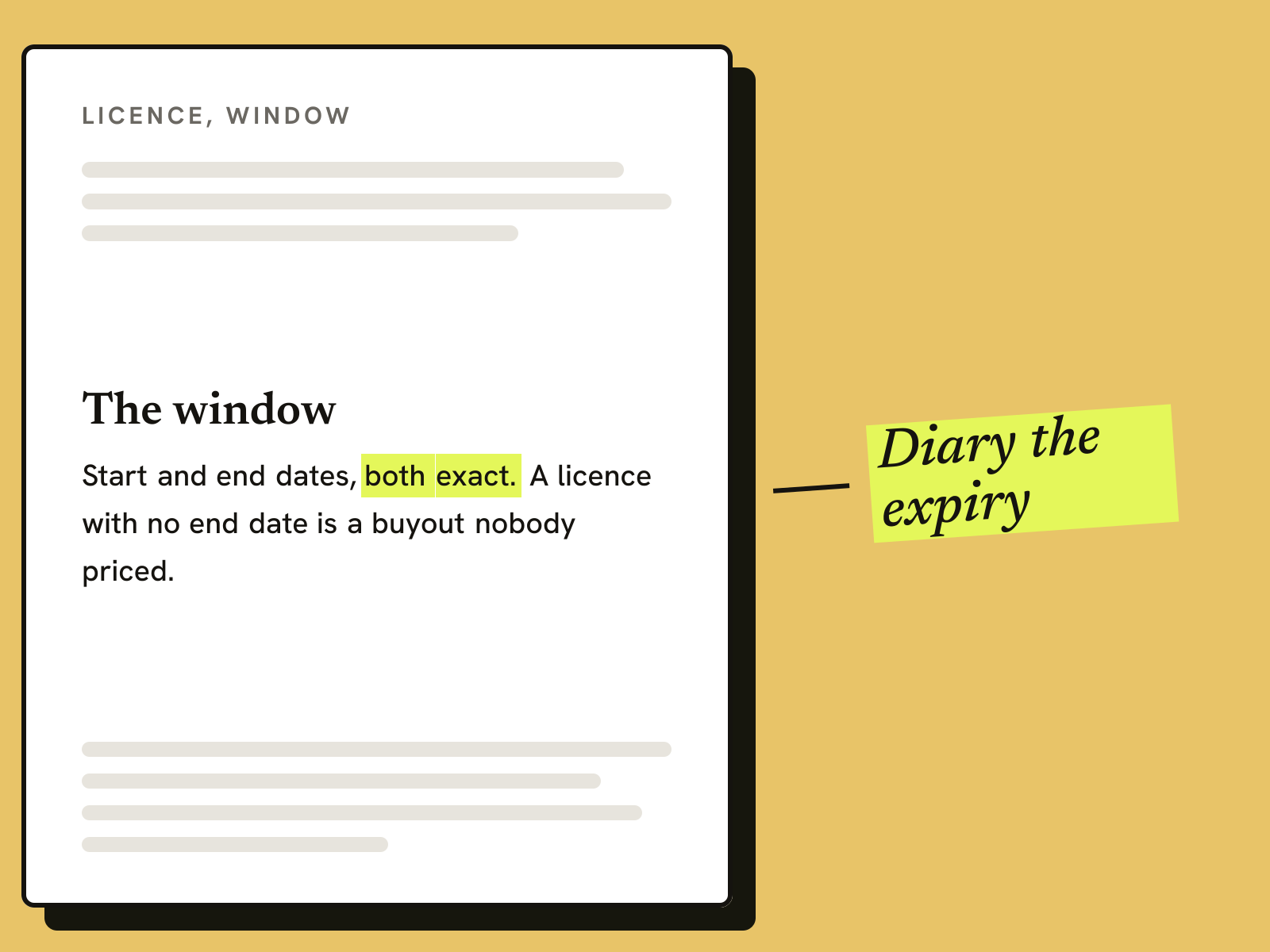 Content Usage Rights for Brands: What to Agree Up FrontHow long and where a brand may use commissioned creator content, what to agree before filming, and what to do when the window ends.
 UGC Creator Contract Template: What to Put in Yours as a BrandThe seven clauses a brand puts in a UGC creator agreement, plus a six-step way to write and sign it without a lawyer.
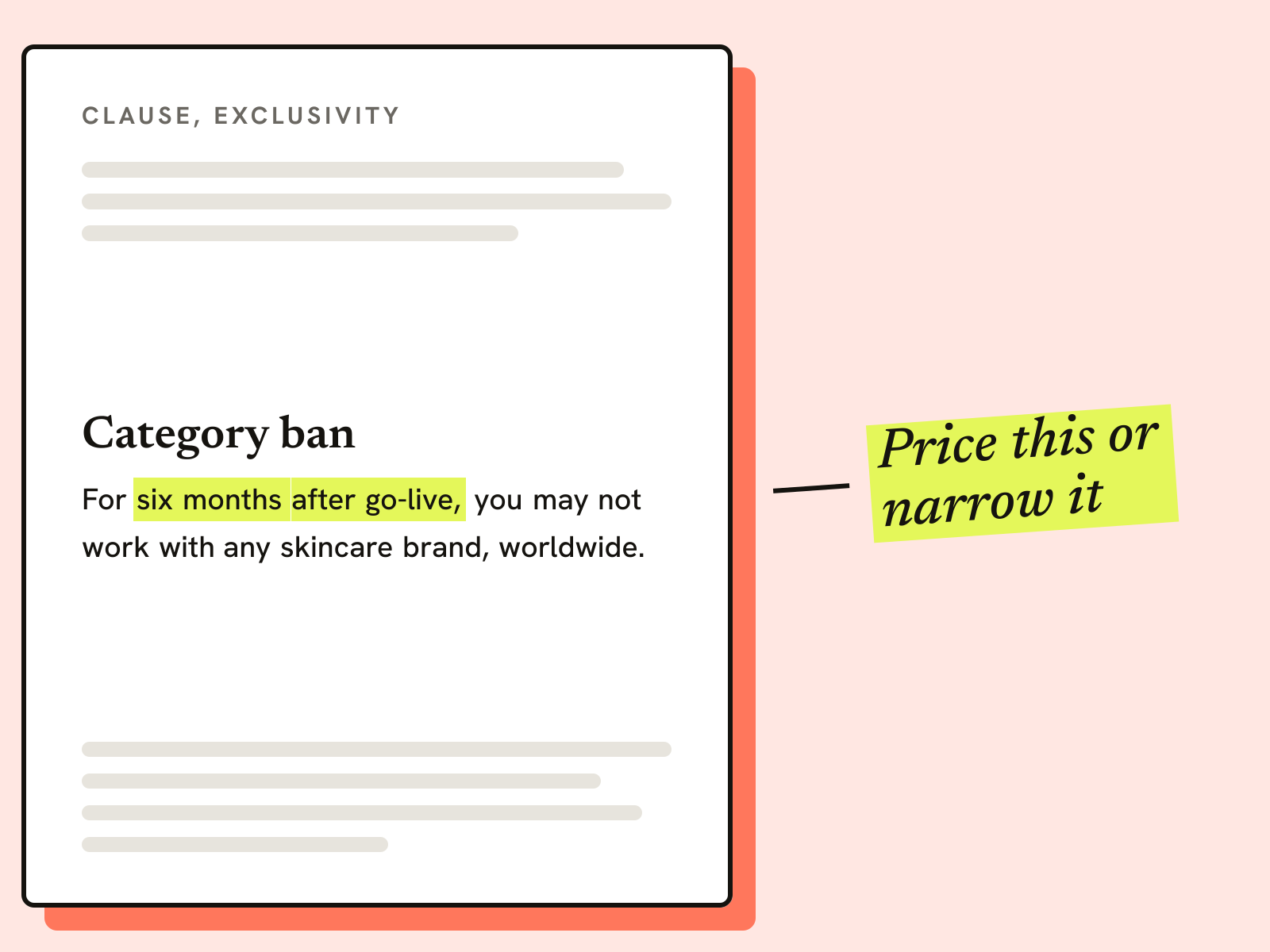 Exclusivity Clause in a Brand Deal: What It Actually BlocksWhat an exclusivity clause actually commits you to, the three questions that shrink it, and the copyable reply that narrows the scope or prices it.