Net 30 Meaning for Creators: When Brands Actually Pay
What net 30 means on a brand deal, when the 30 days start, whether net 60 or 90 is normal, how to ask for a deposit, and the payment line to put in your agreement.
 Written by Jack Evans8 min read

Net 30 means the brand pays the full invoice amount within 30 calendar days of the invoice date, not the day you post. Net 60 and net 90 work the same way, just slower. So send the invoice the day the brand approves your draft, and on a first deal ask for 50% upfront.
On this page
- What is the net 30 meaning on a brand deal?
- Why do payment terms matter so much on your first deal?
- When does the net 30 clock actually start?
- What do net 60 and net 90 mean?
- Is net 30 normal for a brand deal?
- Should you ask for a deposit on your first deal?
- What should the payment line in your agreement say?
- What are the common mistakes with net 30?
- What do you do on day 31 if the brand has not paid?
- Key takeaways
A brand just said "we pay net 30" and you nodded along. The net 30 meaning is simple: the brand pays your full invoice within 30 calendar days of the invoice date, not the day you post. Here is when that clock starts.
What is the net 30 meaning on a brand deal?
Net 30 means the brand pays the full amount on your invoice within 30 days of the date on that invoice. "Net" is old accounting language for the total due, with nothing knocked off. "30" is the number of days the brand has to pay it.
Three details trip up first-deal creators:
- It is 30 calendar days, not working days. Weekends and public holidays count.
- It runs from the invoice date. Not from when you filmed, delivered or posted. No invoice, no clock.
- It is the deadline, not the payday. The brand can pay on day 3. In practice, many finance teams pay near the deadline, on whichever scheduled payment run falls before it.
A worked example. You agree US$1,200 for one TikTok video, a fair number for a creator in the 10k to 50k follower band (US$1,000 to US$4,000 per video). You send the invoice on 21 October with net 30 terms. The money is due by 20 November.
If you are not sure what to charge yet, the Creator Rate Calculator gives you a starting number before you ever talk terms.
Why do payment terms matter so much on your first deal?
Because late payment is normal, and the terms are the only thing you control. IPSE's research on the self-employed found that 35% had not been paid on time by a client in the previous 12 months, and 18% were waiting more than three months past the agreed date (IPSE, late payment within the self-employed sector).
It is rarely personal. When the UK government asked businesses why they pay suppliers late, the top reasons were admin errors, disputed invoices and invoices that got lost, while only 1% said they paid late on purpose (GOV.UK late payments research).
So the fix is boring and in your hands: a clear due date, an invoice sent on time, and a deposit when the brand is new to you.
When does the net 30 clock actually start?
On the invoice date, unless your agreement says something different. That one fact decides when you get paid, because you choose when the invoice goes out.
Same video, same brand, three different paydays:
- Invoice when the brand approves the draft (1 October). Due 31 October.
- Invoice after the video goes live (15 October). Due 14 November.
- Invoice at the end of the month with everything else (31 October). Due 30 November.
Waiting to invoice costs you a month for no reason. Send it the day the brand approves the final draft, or the day your agreement names as the invoice trigger.
Watch for two variations in a brand's own contract:
- "Net 30 from receipt of invoice." The clock starts when their finance team logs it, which can be days later. Email it to the billing address they gave you, not just the person who briefed you.
- "Net 30 EOM" (end of month). The 30 days start at the end of the month you invoiced in. An invoice dated 2 October on net 30 EOM is due 30 November.
If a contract just says "payment within 30 days" with no start point, ask: "30 days from my invoice date?" Get the answer in writing.
What do net 60 and net 90 mean?
Exactly the same thing, with a longer wait. Net 60 means the full amount is due 60 days after the invoice date. Net 90 means 90 days. An invoice sent on 1 October is due 30 November on net 60, and 30 December on net 90.
Some brand paperwork also mentions "2/10 net 30". That means the brand gets 2% off if it pays within 10 days, otherwise the full amount is due in 30. You will rarely see it on a creator deal, and you never have to offer it.
Is net 30 normal for a brand deal?
Yes. Here is how to read each one:
- Net 7 or net 14. Common with small brands and founders who pay from their own account. Great for you, and fair to ask for.
- Net 30. The default for brands with a finance team. Accept it, as long as the clock starts on your invoice date.
- Net 60. Common with large brands and agencies. Agencies often wait for their own client to pay them first. Fine on a bigger deal if you took a deposit.
- Net 90. A red flag on a small deal. The brand is asking you to fund its cash flow for three months after the work is done. Push back.
There is a legal backstop in some places too. In the UK, if no payment date was agreed, the law sets it at 30 days after the client receives the invoice or you deliver the work, whichever is later (GOV.UK, late commercial payments). In the EU, the Late Payment Directive caps business payment terms at 60 days unless both sides expressly agree otherwise and it is not grossly unfair. Rules differ by country, so treat this as a sign of what is normal, not legal advice.
When a brand offers net 90 on a US$1,200 video, send this:
Thanks for sending the agreement. For a project this size I work on net 30 from my invoice date. Could we update the payment terms to that? Everything else looks good to go.
If they say net 90 is fixed by their finance team, ask for a 50% deposit before filming instead. Then you are never waiting three months for the whole fee.
Should you ask for a deposit on your first deal?
Yes. On a first deal with a new brand, 50% upfront is a normal ask, and it is the single best protection you have. You get paid for your time even if the brand goes quiet, and the brand gets a creator who has already committed.
Ask for it in the same message where you confirm the rate, as a standing rule rather than a special favour:
Great, US$1,200 for the video works. For new clients I invoice 50% when we sign the agreement and the other 50% when you approve the final draft, on net 30. I'll send the agreement over today.
If the brand cannot pay a deposit, offer one of these instead:
- shorter terms on the full amount, such as net 14 from approval
- the invoice going out on approval rather than after posting
- files and posting held until the deposit lands, if the timeline is tight
The brand deal contract template shows where the payment terms sit alongside deliverables, revisions and usage rights.
What should the payment line in your agreement say?
One line that answers four questions: how much, when you invoice, when the clock starts, and what happens if payment is late. Copy this and change the numbers:
Payment. Total fee US$1,200. 50% (US$600) is invoiced on signature and due within 7 days. The balance (US$600) is invoiced when the client approves the final draft and is due net 30 from the invoice date. Usage rights begin once the balance is paid. Late invoices carry a fee of 1.5% per month.
Each part is doing a job. "From the invoice date" stops the clock drifting. "Invoiced on approval" stops the brand delaying approval to delay payment. "Usage rights begin once the balance is paid" gives you a calm answer if the brand posts before paying. The late fee only applies because it is written down before you start, which is how it gets taken seriously. How to set up the invoice itself is in how to invoice a brand.
What are the common mistakes with net 30?
- Invoicing after posting, or at month end. Every day you wait to invoice is a day added to your payday.
- Agreeing "30 days" with no start point. Thirty days from what? Always name the invoice date.
- Sending the invoice only by DM. Finance teams pay from an inbox. Email the PDF to the billing contact.
- Leaving out the purchase order number. Bigger brands often cannot pay without one. Ask for it before you invoice.
- Accepting net 90 on a small deal with no deposit. That is three months of free credit to a company bigger than you.
- Staying quiet on day 31. A polite nudge on the first day overdue is routine business, not pushy.

Get paid for your audience. Know exactly what to charge.
A fair price, worked out for you, before the brand asks.
First deal not invoiced in 30 days? The founders sit with you until it is.
Try it free on your next deal14-day free trial · Cancel any time · We never take a commission
What do you do on day 31 if the brand has not paid?
Send one short, factual email to the accounts contact, copy the person you worked with, and reattach the invoice:
Hi [Name], invoice [number] for US$1,200 was due yesterday on net 30 and shows as unpaid on my side. Could you confirm the payment date? I've attached it again in case it went to the wrong inbox.
Most of the time that is enough. If it is not, follow up a week later with a firmer note, then send a final notice at three weeks. The full set of messages is in how to follow up on a late invoice.
This is the step creators forget, because nobody reminds them. In The Creator List, the invoice is made from the deal with the due date set from your terms, and payment reminders are written for the due date, a week later and three weeks later, ready for you to send. It is a 14-day free trial, then a monthly plan (pricing).
Key takeaways
- Net 30 means the full invoice amount is due 30 calendar days after the invoice date.
- The clock starts when you invoice, so invoice the day the brand approves your draft.
- Net 30 is normal. Net 60 is common with big brands and agencies. Net 90 on a small deal is a red flag.
- On a first deal, ask for 50% upfront when the agreement is signed.
- Write the payment line into your agreement, including "from the invoice date" and a late fee.
- On day 31, send a short, polite email with the invoice attached.
Common questions
Net 30 on a brand deal means the brand must pay the full invoice amount within 30 calendar days of the invoice date. The clock starts when the creator sends the invoice, not when the video is filmed or posted, and weekends count. An invoice dated 21 October on net 30 is due on 20 November.
Net 30 is normal for a brand deal, and it is the most common default for brands with a finance team. Net 60 is common with large brands and agencies, which often wait for their own client to pay first. Net 90 on a small deal is a warning sign: the brand is asking a creator to fund its cash flow for three months.
The net 30 clock starts on the invoice date, unless the agreement says otherwise, for example 30 days from receipt of the invoice or 30 days from the end of the month. Because the clock only starts once an invoice exists, a creator who invoices on approval day gets paid weeks earlier than one who waits until after posting.
A creator should ask for a 50% deposit on a first brand deal, invoiced when the agreement is signed and paid before filming. A deposit is a normal term for a new client, and it means the creator is never owed the whole fee for finished work. If the brand refuses, shorter terms on the balance, such as net 14, are a fair middle ground.
On day 31, a creator should email the brand's accounts contact with the invoice number, the amount, the original due date and the invoice attached again, and ask for a confirmed payment date. Most late invoices are stuck in a process, not refused. If there is no reply, a firmer follow-up a week later and a final notice at three weeks are the standard steps.
Get paid for your audience. Know exactly what to charge.
A fair price, worked out for you, before the brand asks.
First deal not invoiced in 30 days? The founders sit with you until it is.
Try it free on your next deal14-day free trial · Cancel any time · We never take a commission
Read next
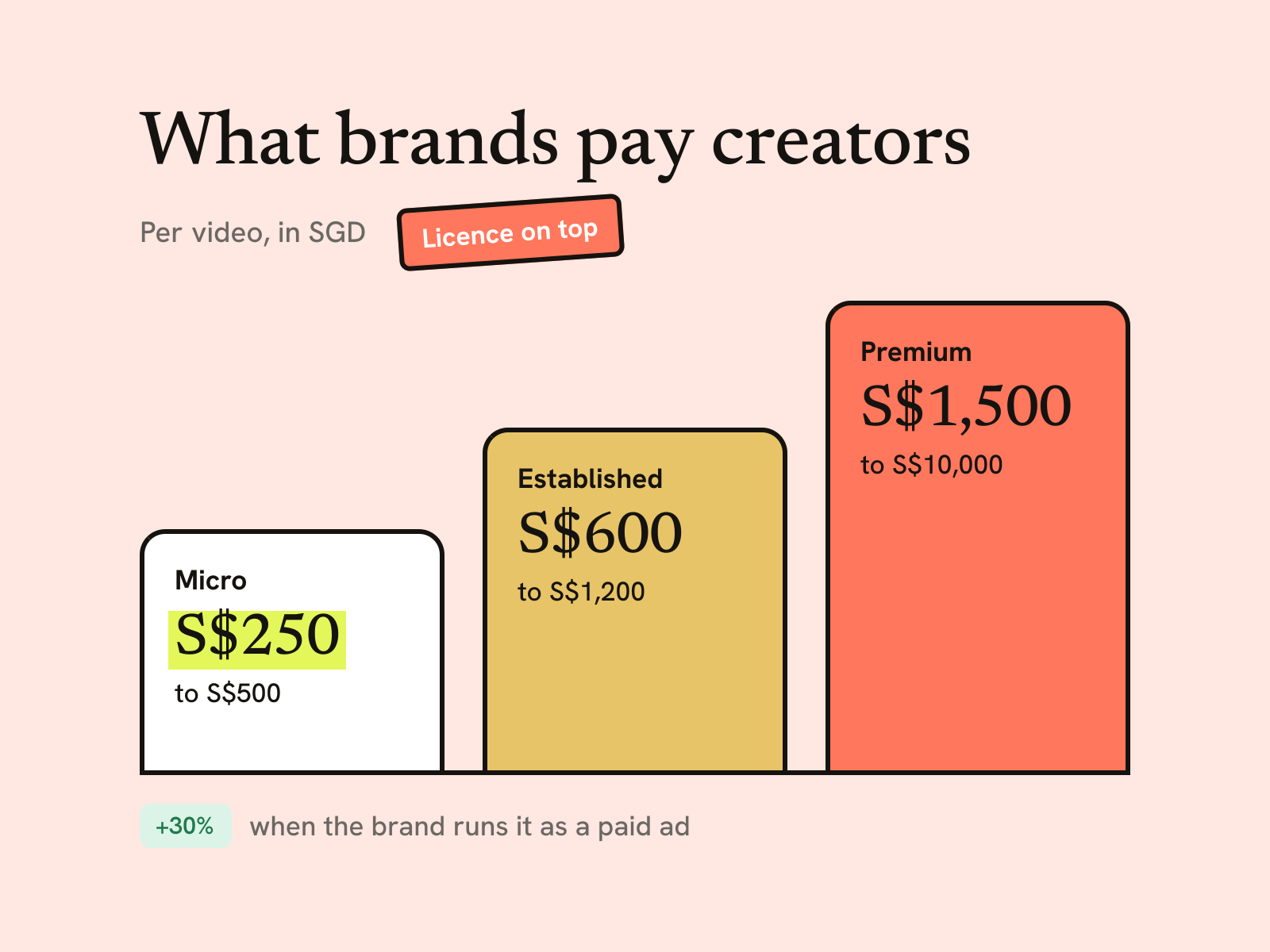 How Much Do Brands Pay Creators in 2026? A Rate GuideWhat the published 2026 benchmarks say brands pay across UGC videos, sponsored posts, whitelisting and retainers, and how to place your own number inside them.
 What to Post to Get Brand Deals When You Have No FollowersWhat a newcomer with no followers should publish so a brand scrolling the profile sees someone worth paying: three formats, five steps and a four-week plan.
 PR Packages Meaning: What Brands and Creators Should KnowWhat a PR package actually is, how it differs from a media kit and a paid creator brief, the five layers that make a box worth filming, and how to run seeding across Singapore and APAC without tripping over customs or disclosure.
 Do you need a business to do brand deals before you start?No registered company is needed for your first brand deal. Here is what to have ready before you invoice, and when registering actually makes sense.