How Much Do Micro Influencers Charge Per Post in 2026?
A first-deal method for pricing one sponsored post as a micro influencer: the published band, the levers inside it, and a quote you can send today.
 Written by Jack Evans7 min read

How much do micro influencers charge? Micro influencer rates sit between about $100 and $2,000 per deliverable, with a single sponsored post usually landing at $150 to $500. Scope, quality and usage set the price; engagement, format and rights decide where in the range you sit.
On this page
How much do micro influencers charge? Micro influencer rates sit between about $100 and $2,000 per deliverable, with a single sponsored post usually landing at $150 to $500. Follower count sets the band; engagement, content type and usage rights decide where in it you sit.
A brand just DM'd you about a post. They call you a micro influencer, they like what you make, and then they ask the question you have been dreading: what is your rate? You have never been paid by a brand, so you have no number ready. You stall, you lowball, or you make something up on the spot. All three cost you the deal.
This guide fixes that today. You will work out one defensible number for one sponsored post, see exactly what moves it up or down inside the micro band, and leave with a message you can send the same day.
What counts as a micro influencer?
A micro influencer is a creator with roughly 1,000 to 100,000 followers, which is most of the people reading this. Brands use that label loosely. Rate guides are stricter. Influencer Marketing Hub's micro influencer rate guide defines micro as 10,000 to 100,000 followers, with anything smaller counted as nano.
The label matters for one reason only: it tells you which budget band the brand is working from. When a brand calls you a micro influencer, they have already decided you are in the paid range rather than the gifted range. They are asking your rate because they have a figure in mind and want to know whether you fit it. No paid work yet? How much to charge for your first brand deal with no past deals starts from the scope instead.
How much do micro influencers charge for one post?
The honest answer is a band, not a number. The same Influencer Marketing Hub guide puts micro rates at roughly $100 to $2,000+ per post or campaign deliverable, with a standard Instagram feed post at about $150 to $500 and a TikTok video at about $200 to $800. YouTube integrations start higher, because long-form video takes longer to make.
Then there is what brands actually pay, which is not always what rate cards say. OpenSponsorship analysed 1,527 completed paid deliverables that ran between January 2025 and June 2026, as reported in Net Influencer's coverage of the study. The median for the micro tier of 10,000 to 50,000 followers was $150 per deliverable. Median, not average. One viral post drags an average somewhere useless, and the median is what a typical campaign costs.
Read those two sources together and the shape is clear. Most micro deals land in the low hundreds. Four figures exist at the top of the band, and they are usually paid for video, a valuable niche, or rights attached. Use the published band as your floor and ceiling, then place yourself inside it with the levers below. For the same numbers across the region, how much influencers make in APAC breaks them down by tier.
A quick sanity check used in rate guides is $10 to $20 per 1,000 followers, a per-follower benchmark listed in that same Influencer Marketing Hub guide. At 25,000 followers that is $250 to $500 for a standard post, which lands inside the published band. Treat it as a starting draft, not a verdict.
What moves the number inside that band?
Five things move you up or down without changing your follower count:
-
Where you sit in the band. 12,000 followers and 90,000 followers are both called micro. The band scales with size.
-
Engagement. Brands pay micro creators for action, not for eyeballs. Micro deliverables cost $3.05 per engagement in that study against $5.00 for mega creators.
-
Content type. A static post is the cheapest thing you can sell. A filmed and edited TikTok sits in the $200 to $800 micro range, and YouTube costs more again.
-
Niche and purchase intent. Beauty, fitness, finance and software audiences get bought because they convert, so those rates run above general lifestyle content.
-
Rights and extras. The base buys one post on your own channels. Ads, whitelisting, exclusivity and raw footage are separate lines, and licensed use often sits well above the base fee.
One more fact worth knowing before you quote. In that same dataset the 50,000 to 250,000 follower tier had the worst cost per engagement of any tier, at $7.07. Brands read those reports. If you sit in the upper half of the micro band, expect harder questions on price and lead with your engagement numbers rather than your follower count.
How do you build a rate you can defend?
Five steps. Ten minutes. You can send the result today.
-
Find your band from follower count
Locate your tier, then do the per-follower maths: $10 to $20 per 1,000 followers gives you a first draft. At 30,000 followers that is $300 to $600 for a standard post, which sits inside the overall $100 to $2,000+ band rather than the $150 to $500 Instagram feed range. If you have no deals yet and want that starting number in your own currency, the Starting Price Calculator in the app does this step for you. There is a 14-day free trial, then a monthly plan on the pricing page.
-
Adjust for engagement, not for follower count
Work out your own number first: likes plus comments across your last ten posts, divided by followers, divided by ten. That is your rough engagement rate. If it has been falling, price at the bottom of your band and fix the content before arguing about money. If it has been rising, price at the top and put the number in your quote.
-
Price the content type, not the account
A static post, a short video and a long-form integration are three different jobs, and the published ranges differ for each: about $150 to $500 for an Instagram feed post, about $200 to $800 for a TikTok video, higher again for YouTube. Quote the format you are actually making. If the brief asks for video, do not send your photo rate and hope.
-
Keep rights and extras outside the base
The base fee buys one post on your own channels, published once. Anything else is a licence: paid ads, whitelisting, a longer window, exclusivity, extra hooks, raw footage. Licensed use is priced separately and often well above the base fee, so never fold it in and hope to be paid later. The full mechanics live in usage rights for creators.
-
Send the quote as line items
Do not send one naked number. Send something a brand manager can forward to a boss. Worked example in USD for a creator with 30,000 followers in a beauty niche. These are example figures for one creator, not a market rate:
Line Price One 30-second Reel, 1 concept, 1 revision, posted on your channels $450 Paid ad use, 30 days $200 Extra cut for testing $75 30-day exclusivity against competing brands $100 Raw footage $90 A simple organic deal closes at $450. The same deal with ad rights and one extra cut is $725. You did not raise your rate. You stopped giving three things away. For a sanity check on your own maths, the Creator Rate Calculator walks the same lines.
How do you say the number out loud?
The number only works if you can type it without wobbling. Copy this, swap the figures for yours, and send:
Thanks for asking. For one 30-second Reel, one concept and one round of revisions, posted on my channels, my fee is $450. That covers you resharing it on your own accounts. If you want to run it as a paid ad for 30 days, that is $200 extra. Happy to send a short breakdown your team can use.
Three things that message does. It names a real number. It says what the number buys. It prices the likely next ask before they make it, so the follow-up becomes a yes or a no instead of a negotiation from zero.
If the brand comes back with "can you do $350?", you are being negotiated with, not insulted. Hold the base, or drop the licence window, or shorten the term. Do not cut the base and throw in ad rights for free.

Get paid for your audience. Know exactly what to charge.
A fair price, worked out for you, before the brand asks.
First deal not invoiced in 30 days? The founders sit with you until it is.
Try it free on your next deal14-day free trial · Cancel any time · We never take a commission
What should you do after the first yes?
Get the scope in writing before you film. One page covering the lines above, the delivery date and the payment terms saves the usual arguments later. The brand deal contract template covers what a first deal needs.
Then invoice from the numbers you quoted. No "actually it ended up being more" emails. If the project grows, add a line and send a revised total, the same way the original quote worked.
Your one job today: write three numbers on a note in your phone. Post, video, 30-day ad rights. The next brand that asks your rate gets the note, not a stall. Once those numbers are settled, an influencer media kit template gives the brand one page to read them from. Naming a number and defending it for ten minutes is the whole test between you and your first paid deal.
Common questions
Micro influencer rates run from about $100 to $2,000+ per deliverable, with a typical Instagram feed post at $150 to $500 and a TikTok video at $200 to $800. Real campaign data puts the median micro deliverable at $150, so most first quotes land in the low hundreds before usage rights and extras.
Followers set the band and engagement decides where a creator sits inside it. Brands pay micro creators for action rather than reach, which is why two accounts at the same follower count can quote different rates: the one with stronger engagement sits at the top of the band.
A micro influencer should charge the same deliverable price on deal one and trade scope instead of the base. If the portfolio piece matters, discount openly for something in return, such as a shorter licence or an extra testimonial, and write the discount into the quote so it does not become the new floor.
A UGC video that never posts to the creator's own channels is priced as content, not as reach. The brand buys the video and the licence, so follower count stops mattering while production, revisions and usage rights set the number.
Get paid for your audience. Know exactly what to charge.
A fair price, worked out for you, before the brand asks.
First deal not invoiced in 30 days? The founders sit with you until it is.
Try it free on your next deal14-day free trial · Cancel any time · We never take a commission
Read next
 How Much Do Influencers Charge in Malaysia? 2026 GuideIndicative RM benchmarks from published sources, the difference between reach and content, and a scope checklist for comparing Malaysian creator quotes.
 How Much Do Influencers Charge in Singapore? 2026 Rate GuideReal 2026 SGD benchmarks for influencer rates in Singapore by band, the usage-rights add-on that quietly doubles budgets, and when UGC content is the smarter buy.
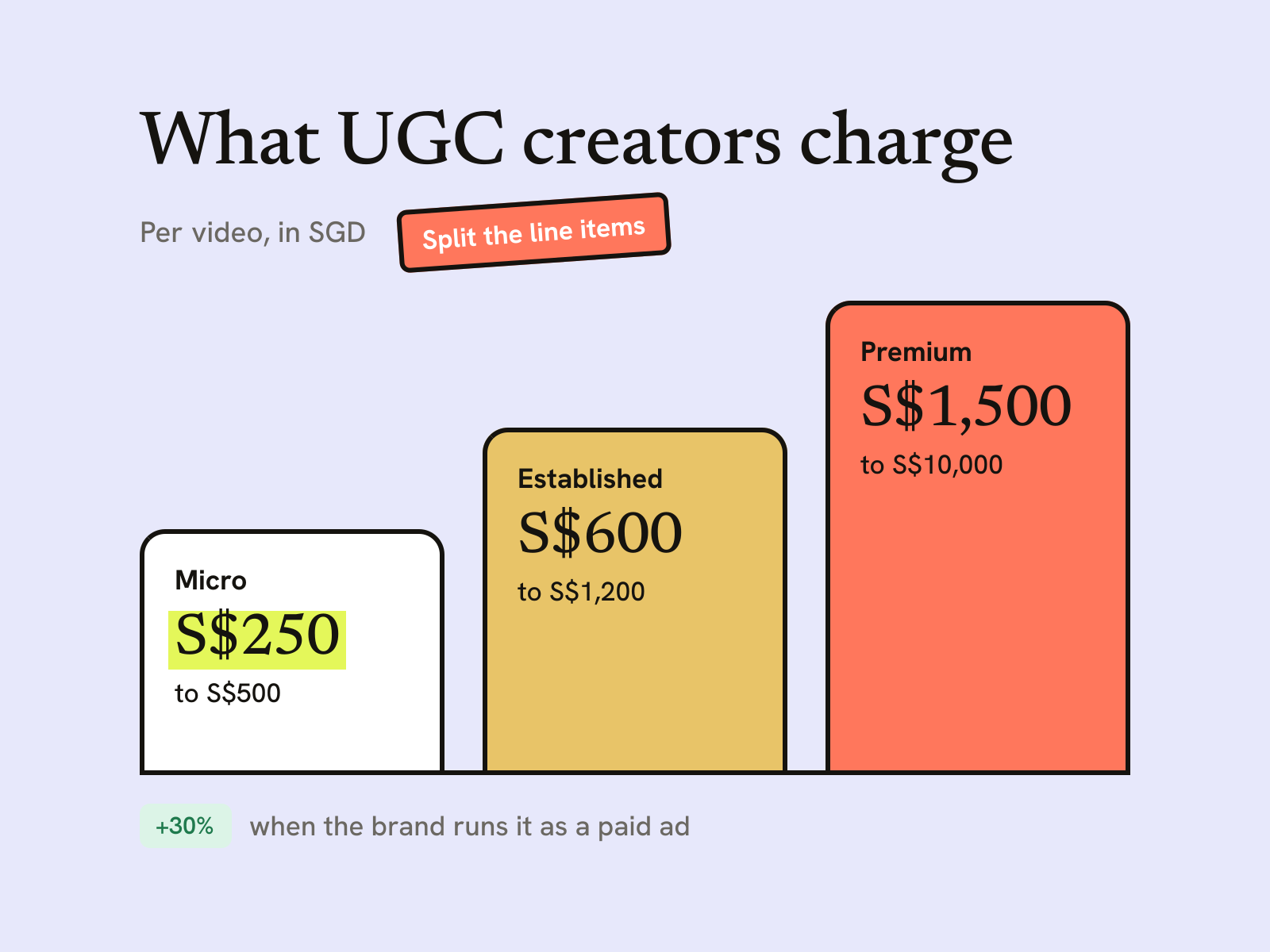 How Much Do UGC Creators Charge for One Video?A worked method for pricing one UGC video when you have never been paid by a brand: base fee, revisions, usage and extras, with a quote you can send today.
 How Much Do Influencers Charge NZ? 2026 Rates GuideNZ influencer and UGC rates in NZD, with tier tables, usage rights and budget examples for local brands.