How Much to Charge for Your First Brand Deal With No Past Deals
The first-deal moment: what to quote with zero paid work behind you, how to frame a first brand deal price without undercutting yourself, and the exact message to send.
 Written by Jack Evans6 min read

How much to charge for your first brand deal comes down to scope, not your past. With no paid work behind you, open near the published beginner band of $75 to $150 for one organic 30-second video, price usage and extras separately, and send the number as a short breakdown instead of a single figure.
On this page
- How much to charge for your first brand deal?
- Why does a first-deal price feel like a guess?
- How do you work out your number with no past deals?
- What do you say when the brand asks "what is your rate"?
- How do you frame a first-deal price without undercutting yourself?
- What should you do right after they say yes?
How much to charge for your first brand deal comes down to scope, not your past. With no paid work behind you, open near the published beginner band of $75 to $150 for one organic 30-second video, price usage and extras separately, and send the number as a short breakdown instead of a single figure. Whether to quote that band in USD or your local currency is a separate call, covered in should I charge in USD or local currency.
The DM arrived this morning. A brand whose product already sits in your bathroom has seen your last three videos, has a brief ready, and wants your rate before they book the call. You have an audience, you have never sent an invoice, and you have nothing to base a number on. So you draft a reply, delete it, and draft another. This guide ends that loop. You will leave with a figure you can defend and a message you can paste, plus one thing to do in the next ten minutes.
How much to charge for your first brand deal?
The honest answer is a band, not a figure plucked from your head. Published 2026 rate data puts beginners, meaning roughly your first ten deals, at $75 to $150 for one 30-second organic video, with the full beginner range running $50 to $200 (30DayPivot's 2026 UGC rate tables). The same page adds that the very first one to five gigs often land at $50 to $100 or product plus a small fee, and treats that as a short portfolio-building phase rather than a rate to stay at.
Real money lands near the same point. Influencer Advisory reports a $120 median per-post fee for nano creators with 1,000 to 10,000 followers, drawn from 176,223 sponsor deals it tracks (Influencer Advisory). A typical first deal for a creator your size therefore sits inside the band, not under it.
So for one organic 30-second video with one revision, open at $100 to $150. Quote $75 only when the brief is thin and you want the portfolio piece. Nothing in the data rewards opening at $20 because it is your first deal.
Why does a first-deal price feel like a guess?
Because you are pricing with no receipts, and two fears pull in opposite directions. Quote high and you assume the brand silently closes the tab. Quote low and you think you have locked yourself into a number you cannot raise. Both fears are about the same thing: being judged on a figure you invented alone.
The other side of the table is guessing too. A Censuswide survey of 1,000 marketing and procurement decision-makers at brands in the US and UK found that 45% had paid above or below fair market value on a creator partnership, and only 44% said they were fully confident in their ability to negotiate fair rates (Net Influencer). A clear number with the scope attached makes you the most organised person in that conversation. The brand is not testing whether you are worth it. They are testing whether you can be worked with.
How do you work out your number with no past deals?
Five steps, about ten minutes. You can send the result the same day.
-
Write down what they actually asked for
Count the deliverables, the length, the deadline, and where the content will run. "One 30-second video for our TikTok next fortnight" and "four videos plus three story frames, running as ads" are different jobs. Price the job in front of you, not the size of the brand asking.
-
Take the band, not a feeling
Start from $75 to $150 for one organic video, then move inside it: up for a tight deadline or a niche you already post about, down for a loose brief you want as a portfolio piece. If you would rather not do that arithmetic in your head, the Starting Price Calculator in The Creator List gives you a starting price before you have any deals, in your own currency.
-
Set a floor and a ceiling before you reply
The floor is the lowest number that makes the afternoon worth it. The ceiling is the top of the beginner band. Write both down first. Every counter-offer from that point is a number between two you already chose, instead of a verdict on your worth.
-
Keep usage, revisions and extras out of the first number
Organic posting on the brand's own channels belongs in the fee. Paid ads, whitelisting, extra hooks and rush delivery are separate lines you can add later. What paid ads and whitelisting usually cost is set out in UGC usage rights cost on a first deal. The method for splitting a quote into those lines lives in how much do UGC creators charge, and the rights ladder is covered in usage rights for creators.
-
Say the number out loud once, then send it
Read your own message back before it goes. If you cannot say the number out loud without flinching, it is wrong for this brief rather than wrong for you. Adjust inside the band, then send.
What do you say when the brand asks "what is your rate"?
The question deserves one message, not three nervous paragraphs. Here is the message. Swap the figures for yours and send it:
Thanks for thinking of me for this. For one 30-second vertical video with a single concept, one round of revisions and delivery in seven days, my fee is $135, and that covers you posting it on your own channels. If you want to run it as a paid ad for 30 days, add $40. Tell me if anything else needs pricing and I will send it the same way.
The brand can forward that message without translating it. The fee and the scope arrive together, and the likely next ask, paid ads, already has a price attached, so the reply you get is a yes or a no instead of a blank.
If they come back with "can you do $90?", you are not being insulted. You are being negotiated with. Trade something other than the fee:
- Shorten the paid-ads window from 30 days to 14
- Drop the second revision round
- Move the delivery date out a week
- Keep the fee and cut an extra hook instead
How do you frame a first-deal price without undercutting yourself?
Say the price, then say what it covers. Do not announce a discount for being new, and do not apologise for having no paid work behind you. A discount on top of the band gives the brand a second, lower anchor to negotiate from, and that anchor is the one they keep.
Four lines worth deleting from your first quote:
- "I'm new, so make me an offer." You just handed them the pen.
- "My rate is $250." A ceiling outside the published band, with no paid deals behind it, invites a flat no.
- "Whatever you think is fair." That lands at the bottom of their budget, not the middle of yours.
- "Just send me the product." Gifting is not a first paid deal, and it does not become one by waiting.
Honest framing is simpler than any of those. Name the fee, name the scope, and if the brand asks why the number is what it is, the answer is the deliverables in front of you. First-deal prices are entry prices. They are not apologies.

Get paid for your audience. Know exactly what to charge.
A fair price, worked out for you, before the brand asks.
First deal not invoiced in 30 days? The founders sit with you until it is.
Try it free on your next deal14-day free trial · Cancel any time · We never take a commission
What should you do right after they say yes?
Before anything gets filmed, turn the quote into a written agreement covering what is included, the delivery date and the payment terms. The brand deal contract template has the clauses a first deal needs.
After the first invoice, carry the number forward instead of reopening it. A rate card holds your starting price, usage and extras behind one link, so the second brand reads your price rather than asking for it. The rate card guide builds that one-pager from the quote you have already sent. If brands ask for a media kit rather than a rate card, Beacons media kit vs rate card explains which one they expect.
Your one next action: paste the message above into the thread waiting on you today, before you open another rate guide. A figure you chose yourself, said plainly, is what a first paid deal actually turns on.
Common questions
A first brand deal with no paid work behind it should open between $75 and $150 for one organic 30-second video with one revision. That band is the published beginner range for 2026, and it already prices in the missing paid history, so the number needs no further discount.
No. A first brand deal price should sit inside the beginner band rather than below it. A discount on top of an already-entry-level fee gives the brand a lower anchor to negotiate from, and that anchor is the one they remember on deal two.
Send one message that names the fee, the scope and the add-ons: 'One 30-second video, one concept, one revision, delivered in seven days, $135 for your own channels. Paid ads for 30 days add $40.' Clear scope is what makes a first brand deal price defensible.
Both fail the same way. A quote outside the published $75 to $150 beginner band needs paid history to justify it, which a first brand deal does not have. Quote inside the band, attach the scope, and let the brand negotiate on the lines rather than on the fee.
Get paid for your audience. Know exactly what to charge.
A fair price, worked out for you, before the brand asks.
First deal not invoiced in 30 days? The founders sit with you until it is.
Try it free on your next deal14-day free trial · Cancel any time · We never take a commission
Read next
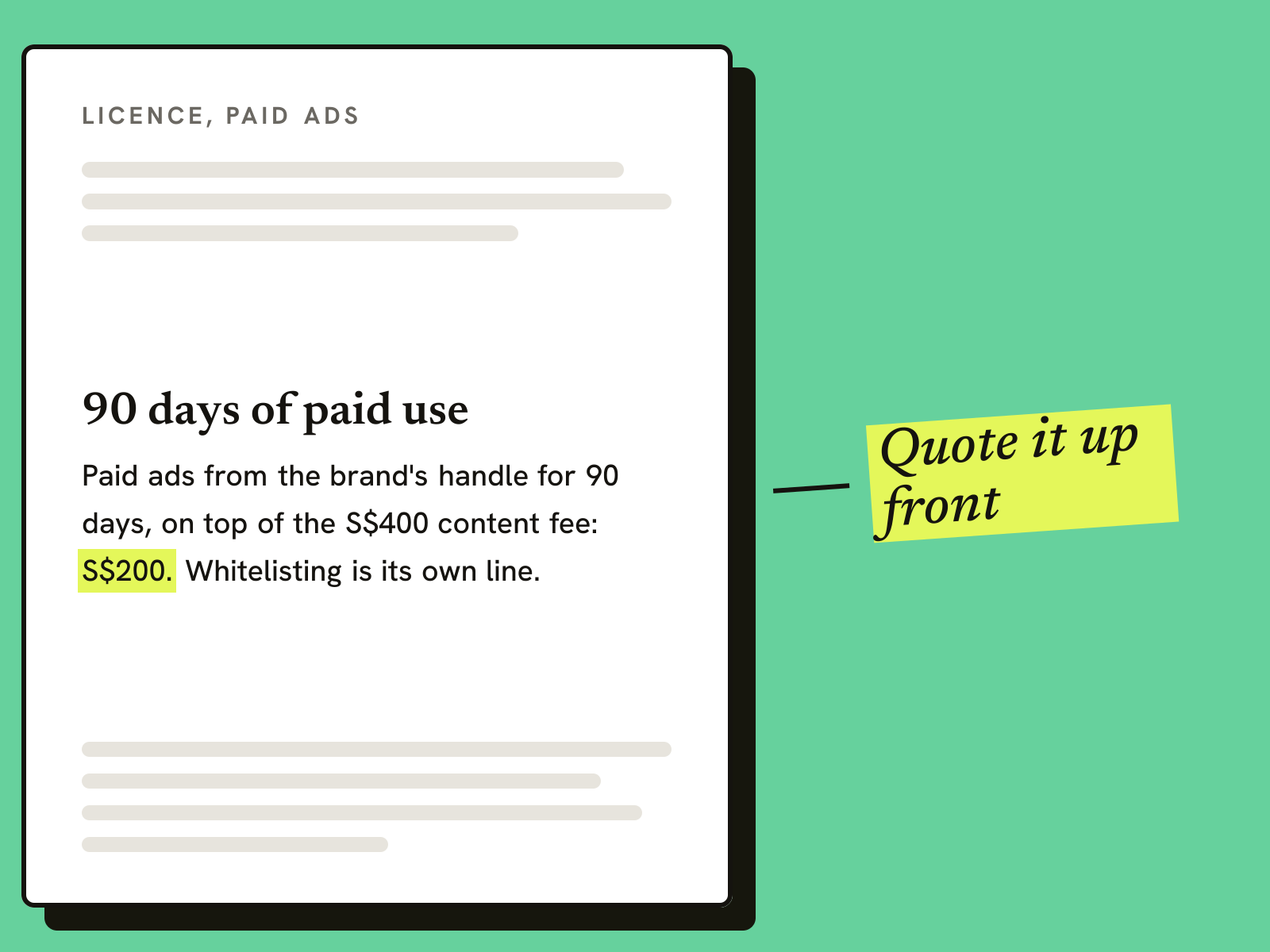 UGC Usage Rights Cost: Pricing Ads on a First DealWhat UGC usage rights cost when a brand asks for ad rights or whitelisting on a first paid deal, with numbers to say out loud and a reply to copy.
 How to Get Brand Deals as a New Creator With No FollowersA step-by-step path for a new creator with no followers: who to contact, one message to send today, and a starting price to quote.
 What to Post to Get Brand Deals When You Have No FollowersWhat a newcomer with no followers should publish so a brand scrolling the profile sees someone worth paying: three formats, five steps and a four-week plan.
 How Long to Get Your First Brand Deal, Honestly ExplainedAn honest look at the first brand deal timeline: what sets it, why silence is arithmetic rather than rejection, and a weekly checklist to show whether you are on track.