How Much Do UGC Creators Charge for One Video?
A worked method for pricing one UGC video when you have never been paid by a brand: base fee, revisions, usage and extras, with a quote you can send today.
 Written by Jack Evans7 min read

UGC creators charge for one video with a base fee plus separate lines for revisions, usage rights and extras. A first-time creator typically opens near US$75 to US$150 for an organic 30-second video. The number holds up when the brand can see what each line buys.
On this page
UGC creators charge for one video with a base fee plus separate lines for revisions, usage rights and extras. A first-time creator typically opens near US$75 to US$150 for an organic 30-second video. The number holds up when the brand can see what each line buys.
A brand you follow just DM'd you. They like your videos. They want one for their product. Then they ask the question you have been dreading: what is your rate for one video?
You freeze. You have no defensible answer to the big question: how much do UGC creators charge for one video? You are also terrified of quoting too high or too low. So you stall, or you throw out a number you made up on the spot. This guide fixes that today. You will build one defensible price for one video, line by line, and leave with a message you can send.
What is a UGC video rate actually made of?
A single "rate" is really four separate prices stacked on top of each other. Most first-time creators mash them into one vague number, then get ambushed when the brand asks for something extra.
Those four lines are:
- Base fee - one edited video, one concept, an agreed length, one round of revisions, delivered in an agreed window. This covers organic posting on the brand's own channels.
- Revisions - the first round is included in the base. Every round after that is a new line, usually 25% to 50% of the base fee.
- Usage rights - permission to use the video beyond a normal organic post. Paid ads, whitelisting, websites, email, longer licences. Priced by window, not guessed.
- Extras - extra hooks, raw unedited footage, rush turnaround, photo add-ons. Only charge these when asked. Never donate them.
Keep the four lines apart and every quote becomes a conversation about scope, not a haggle over your worth.
How much do UGC creators charge right now?
You need a starting band, not a fantasy number. The market is wide, but it is not random. If your offer is a post rather than a video, how much micro influencers charge per post gives the comparable band.
The Influencer Marketing Hub 2026 benchmark found roughly 80% of UGC creators price individual deliverables under $500. That is not a ceiling. It is proof that most of the market trades well below the loud six-figure screenshots. For the wider rate picture across deal types, how much brands pay creators in 2026 lays out each band.
Inside that, Framekit's 2026 rate card guide puts beginners at about $50 to $150 per organic video and established creators around $150 to $350. The Q3 2026 UGC Rate Index puts the centre of the market for a single video near a $175 median before rights and extras. A sensible first quote sits near the top of that entry band, around $75 to $150.
Two traps hide in those numbers. First, averages pull upward because specialists charging $500 and up drag the mean. Quote from the median, not the mean. Second, follower count barely moves UGC prices. Brands buy the content and the licence, not your audience reach.
Use the band as an anchor, then adjust for what the brief actually asks for. If you have no paid deals yet and want a starting number in your own currency before this first DM, the Starting Price Calculator in the app does that step for you.
How do you build one number for one video?
Here is the method. Five steps. You can finish it in ten minutes and send the result the same day.
-
Pick your base from the band, not from thin air
Open at $75 to $150, near the top of the published beginner band, for one organic 30-second video with one revision. Move toward the top of it if your portfolio is strong for the niche they are in (skincare demos, tech walkthroughs, fitness hooks). Stay near the bottom if the brief is simple and you need the portfolio piece.
Write the base as a flat fee with limits attached: length, concept count, revision count, delivery days. An unlimited base is how scope creep starts. For a quick sanity check on your maths, the Creator Rate Calculator walks the same four lines.
-
Lock one revision round into the base, price the rest
Say "one round of revisions included" in the quote. If they want a second pass, charge 25% to 50% of the base. On a $120 video that is $30 to $60 per extra round. This stops the silent free re-shoot that eats an afternoon.
-
Price usage as its own line, never inside the base
Organic posting on the brand's own channels stays in the base. Anything else is a licence:
- Paid ads, 30 days: about +30% of base (on $120, that is $36)
- Paid ads, 90 days: about +50% of base (on $120, that is $60)
- 12 months of paid use: roughly +100%, so the licence alone doubles the deal
- Perpetual buyout: quote per campaign, or decline
These percentages follow the published ladder in the Q3 2026 UGC Rate Index, not a personal invention. If a brand says "we just want to run ads for a month," that is still a paid licence. Say yes, and name the price. The fuller mechanics live in usage rights for creators.
-
Add extras only when the brief asks
Extra hooks (alternate openings for ad testing) are commonly about $50 each, roughly $25 to $150. Raw unedited footage runs about 30% to 50% of base, because it lets their editor cut new ads without you. Rush under 48 hours adds 25% to 50%. If none of that appears in the brief, leave the lines off. You can always add them mid-conversation without reopening the base.
-
Write the quote as line items and send it
Do not send one naked number. Send a short breakdown the brand can forward to their boss. Worked example, USD:
Line Price One 30-second video, 1 concept, 1 revision, 7-day delivery, organic use $120 Second revision round, if needed $40 Paid ads, 30 days $36 Each extra hook $50 Raw footage $50 A simple organic deal closes at $120. Add 30-day ad rights and two hooks and the same video is $256. You did not raise your rate. You stopped giving away three things for free.
When you want a written rate card to attach to later pitches, the rate card guide turns this table into a one-pager.
How do you say the price out loud?
The number only works if you can type it without wobbling. Copy this, swap the figures for yours, and send:
Happy to make this. For one 30-second video, one concept, one round of revisions and delivery within seven days, my fee is $120. That covers you posting it on your own channels. If you want to run it as a paid ad for 30 days, that is an extra $36. Extra hooks are $50 each if you want alternates for testing. Want me to send a simple breakdown so you can share it with your team?
Three things this message does. It names a real number. It says what the number buys. It prices the next likely ask before they ask, so the follow-up is a yes or no, not a negotiation from zero.
If the brand comes back with "can you do $80?", you are not being insulted. You are being negotiated with. Hold the base, or drop an extra, or shorten the licence. Do not cut the base and throw in ad rights for free.

Get paid for your audience. Know exactly what to charge.
A fair price, worked out for you, before the brand asks.
First deal not invoiced in 30 days? The founders sit with you until it is.
Try it free on your next deal14-day free trial · Cancel any time · We never take a commission
What should you do after the first yes?
Get the scope in writing before you film. A short agreement covering the four lines, the delivery date and the payment terms saves the usual post-project arguments. The brand deal contract template covers the minimum you need on deal one. If you have not filmed one yet, how to make a UGC video on your phone in one afternoon covers the shoot itself.
Then invoice from the same numbers you quoted. No "actually it ended up being more" emails. If the project grows, you add a line and send a revised total, the same way the original quote worked. Once the deal is invoiced, Beacons media kit vs rate card: which one brands want helps you decide what to send next. If editing starts eating your week as the work grows, when to hire a video editor is the next question to answer.
Your first paid deal is not a test of whether you are worth it. It is a test of whether you can name a number and defend it for ten minutes. Build the four lines, send the breakdown, and let the brand respond to a clear price instead of to your nerves.
Common questions
First-time UGC creators usually open between $75 and $150 for one organic 30-second video. That band sits inside the published entry range and leaves room to add usage rights, extra hooks or rush delivery as separate lines rather than baking them into the base.
No. UGC pricing is per deliverable, not per follower. Brands buy the video and the licence to use it. A creator with 800 followers who films a clean 30-second demo competes on the same rate ladder as a creator with 20,000, provided the work meets the brief.
Only organic posting on the brand's own channels belongs in the base fee. Paid ads, whitelisting and longer licences are add-ons. A common ladder is about +30% of the base fee for 30 days of paid ads, +50% for 90 days and +100% for 12 months.
Send one short breakdown: base fee, what it includes, then separate prices for usage, extra hooks and rush. Example: 'One 30-second video, one concept, one revision, $120. Paid ads for 30 days add $36. Extra hooks $50 each.' Clear line items end the guesswork on both sides.
Get paid for your audience. Know exactly what to charge.
A fair price, worked out for you, before the brand asks.
First deal not invoiced in 30 days? The founders sit with you until it is.
Try it free on your next deal14-day free trial · Cancel any time · We never take a commission
Read next
 How Much Do Influencers Charge in Malaysia? 2026 GuideIndicative RM benchmarks from published sources, the difference between reach and content, and a scope checklist for comparing Malaysian creator quotes.
 How Much Do Micro Influencers Charge Per Post in 2026?A first-deal method for pricing one sponsored post as a micro influencer: the published band, the levers inside it, and a quote you can send today.
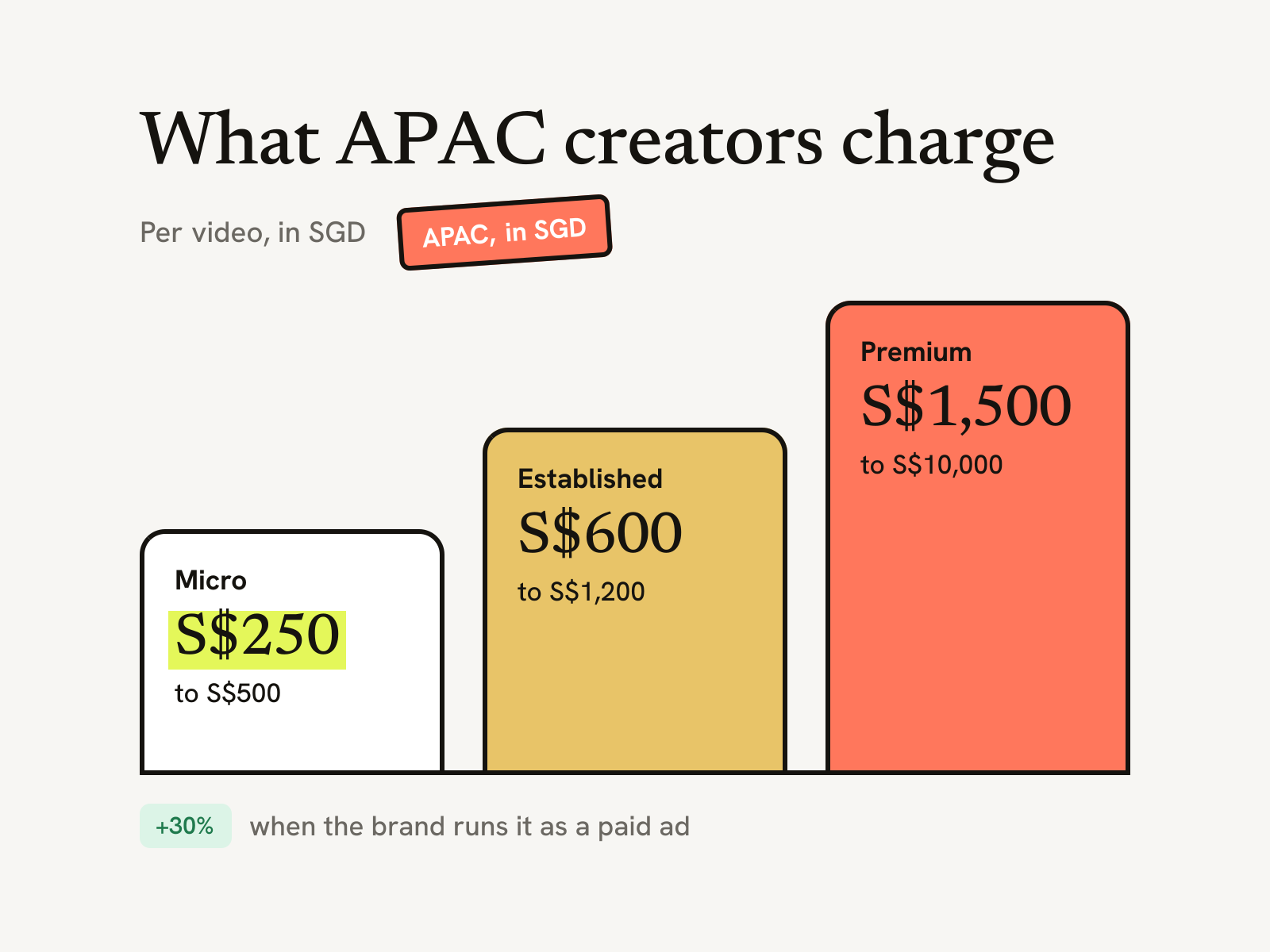 UGC Creator Rates 2026: What APAC Creators ChargeLocal-currency UGC and influencer rate bands across seven APAC markets, the reach versus content distinction that fixes mispriced briefs, and the usage-rights line that inflates budgets.
 How to Make a UGC Video on Your Phone in One AfternoonA phone-only filming guide for a first UGC sample: shot list, light, sound, length and export settings to film this afternoon.